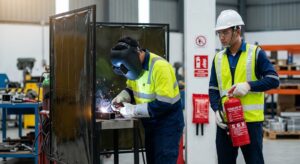


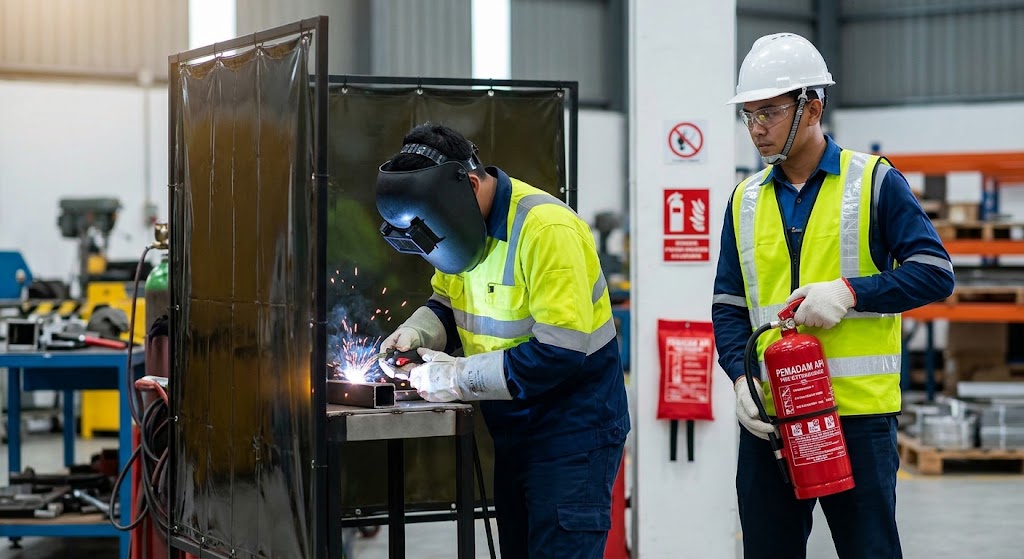
A hot work permit Malaysia workplace uses provides a structured way to control fire risks before welding, cutting, grinding or similar activities begin.
Hot work can produce flames, sparks, heat and hot metal fragments. These ignition sources may travel beyond the immediate work area and ignite combustible materials that workers did not notice during normal operations.
Therefore, employers should not treat welding or grinding as routine maintenance simply because employees perform these activities regularly.
A safe hot work process starts before anyone switches on the equipment. The organisation must assess the work area, identify combustible materials, establish suitable controls and confirm that responsible personnel understand their roles.
The permit then records these precautions and confirms that the job may proceed under the stated conditions.
The Department of Occupational Safety and Health Malaysia recognises permit-to-work systems as an important control for higher-risk activities, including hot work.
What Is Hot Work?
Hot work describes activities that can generate enough heat, flame or sparks to ignite surrounding materials.
Welding provides one obvious example. However, many workplaces perform other activities that can create similar ignition risks.
These activities may include flame cutting, brazing, soldering, grinding and work involving rotating cutting discs.
The risk does not come only from the equipment itself.
A spark from grinding can travel away from the worker. Molten metal can fall through floor openings. Heat can also transfer through metal surfaces and ignite materials on the opposite side of a wall or partition.
As a result, workers need to assess more than the area directly in front of them.
What Is a Hot Work Permit?
A hot work permit is a controlled authorisation process used before specified hot work begins.
It confirms that the responsible parties have reviewed the task, assessed the hazards and implemented the required precautions.
DOSH guidance describes a permit-to-work system as a written safety control for work involving foreseeable high hazards. The document identifies the work and the precautions that workers must follow.
A hot work permit therefore acts as more than a signature form.
The permit should reflect the actual conditions at the worksite. If those conditions change significantly, the team should stop and review the work rather than assuming the original approval remains suitable.
Employers can review the official DOSH guidance on permit-to-work systems for further information on formal safe systems of work.
Why Hot Work Creates a Serious Fire Risk
A visible welding flame makes the danger easy to recognise. However, fires can also start after workers believe they have completed the job safely.
A spark may enter a small gap behind machinery. Hot material may fall underneath a platform. Heat may transfer through a metal surface and affect combustible material on the opposite side.
These conditions can create a smouldering fire that becomes visible later.
Hot work risk becomes greater when the area contains cardboard, timber, plastic, insulation, oil, fuel or flammable chemicals.
Poor housekeeping increases the problem further.
For this reason, an organisation should assess the surrounding work area instead of looking only at the welding point.
FERA’s guide to fire prevention for offices, factories and warehouses also highlights hot work control as an important part of workplace fire prevention.
When Should a Workplace Use a Hot Work Permit?
A company should use a hot work permit when the work creates an ignition source in an area where fire or explosion hazards may exist.
The organisation’s own risk assessment and permit-to-work procedure should define exactly which activities require authorisation.
A typical workplace may require a permit for welding, flame cutting, brazing, grinding and selected maintenance activities involving open flames or significant heat.
The permit becomes especially important when contractors perform temporary work outside a dedicated workshop.
For example, welding inside a controlled fabrication area may follow established operating procedures. However, repairing a pipe beside stored packaging presents a completely different risk.
Similarly, cutting metal near a chemical storage area requires more control than carrying out the same task in an isolated workshop.
The organisation should assess each situation rather than relying only on the name of the activity.
What Should Be Checked Before Hot Work Begins?
The person responsible for authorising the job should inspect the work area before issuing the permit.
The inspection should identify combustible materials, nearby equipment and possible routes through which sparks or heat could travel.
Where practical, workers should remove combustible materials from the area. When removal is not possible, the team may need suitable shielding or fire-resistant protection.
The organisation should also check whether the work could affect equipment or materials behind walls, above ceilings or below the working level.
Suitable firefighting equipment should remain immediately accessible. Workers must know the emergency alarm procedure and evacuation route.
DOSH’s construction permit-to-work example specifically includes controls such as providing a fire extinguisher, keeping the area free from combustible material, using appropriate protective equipment and ensuring welding equipment remains in good condition.
The Hot Work Permit Process
A practical hot work process should remain simple enough for employees to follow but detailed enough to manage the actual risk.
First, the requester describes the work, location and expected duration.
Next, the responsible person assesses the hazards and confirms the controls. The organisation then authorises the work only after all required precautions are in place.
During the activity, workers must follow the permit conditions.
After the job finishes, the responsible person should inspect the area again before formally closing the permit.
This final stage matters because an ignition source may remain after the welding or grinding stops.
The permit process can therefore follow five broad stages:
Request → Assess → Authorise → Monitor → Close
The company should define who may perform each stage.
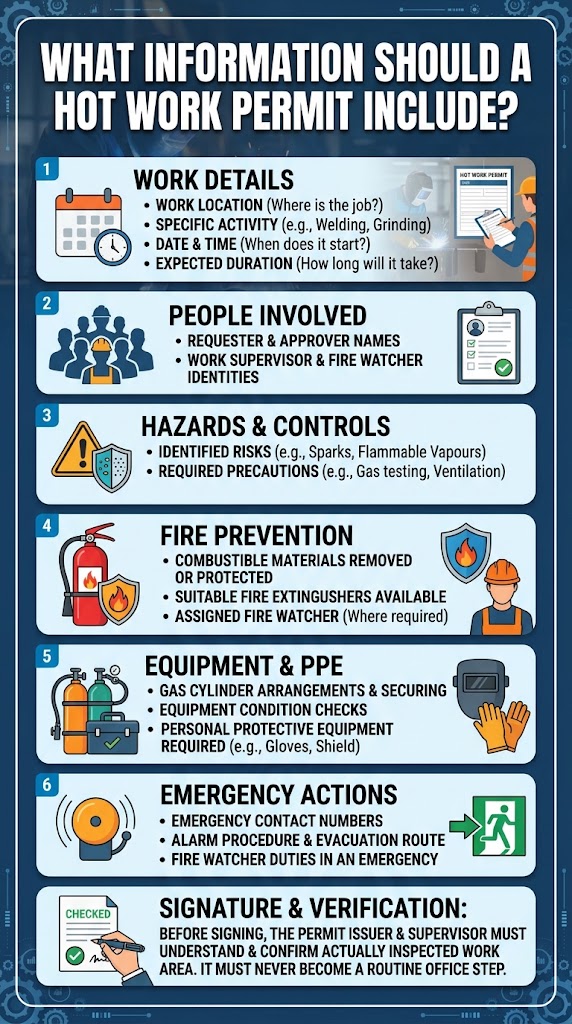
What Information Should a Hot Work Permit Include?
A useful permit should clearly identify what workers can and cannot do.
The document normally records the work location, activity, date, expected duration and people involved.
It should also describe the main hazards and required control measures.
For example, the permit may confirm that combustible materials have been removed, suitable extinguishers remain available and a fire watcher has been appointed where required.
The form may also record gas cylinder arrangements, equipment condition, personal protective equipment and emergency actions.
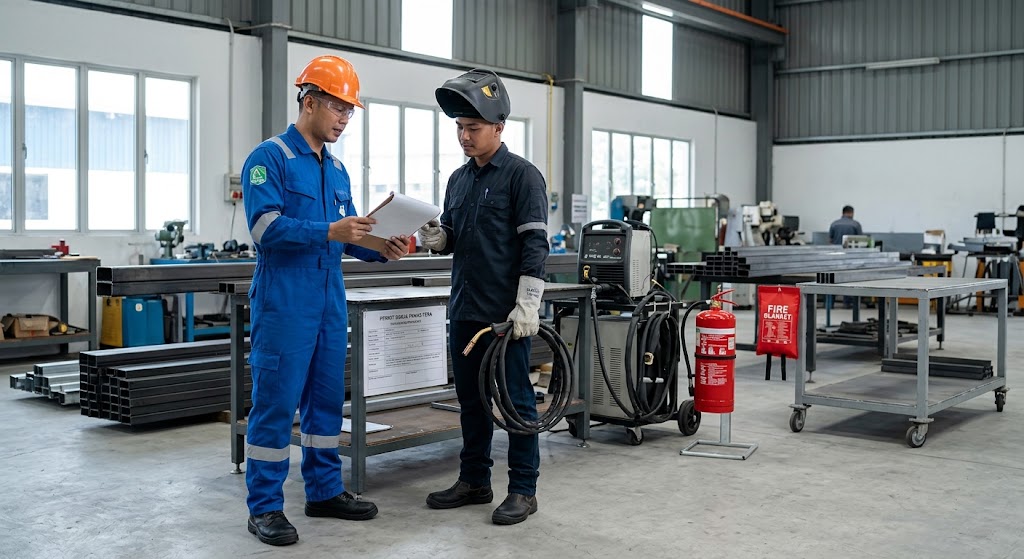
The permit issuer and work supervisor should understand the document before signing it.
A signature should confirm that someone has actually inspected the work area. It should never become a routine administrative step completed from an office.
What Is a Fire Watcher?
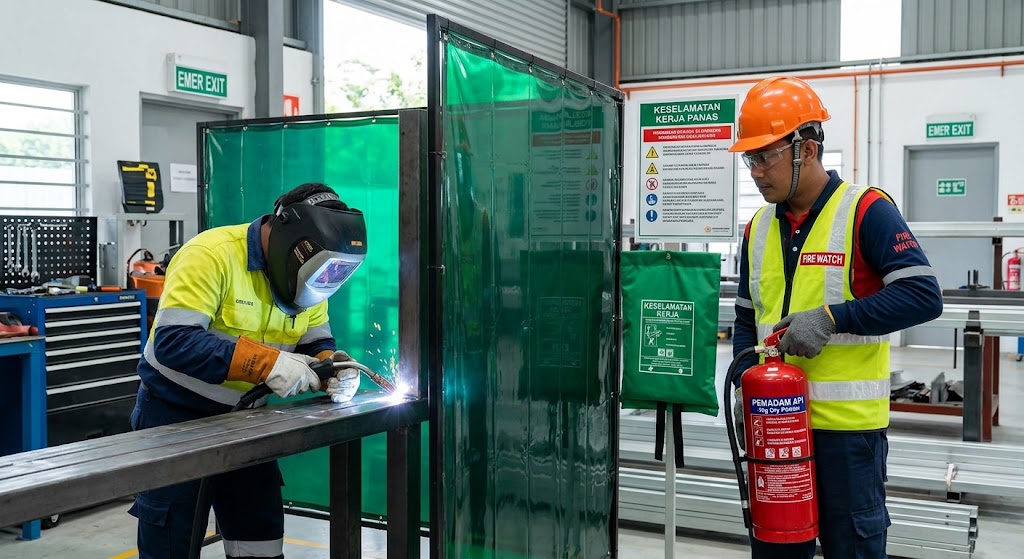
A fire watcher, sometimes called a fire watch, monitors the area during hot work and looks for signs of ignition.
The role is particularly important when the person carrying out the work cannot continuously observe the surrounding area.
A welder may focus on the task and may not notice sparks travelling behind equipment or through an opening.
The fire watcher provides that additional observation.
The person should understand the workplace emergency procedure and know how to raise the alarm.
Where appropriate, the fire watcher should also understand how to use the available first-response firefighting equipment.
However, the role does not mean the employee should attempt to control a fire that has already become unsafe.
The watcher must prioritise alarm activation and evacuation when conditions exceed the limits of an initial response.
How Long Should Fire Watch Continue After Hot Work?
The organisation should define the required post-work monitoring period through its risk assessment, site procedure and applicable technical requirements.
Management should not assume that risk ends as soon as workers switch off the welding equipment.
Heat can remain within metal, insulation or hidden spaces.
Therefore, the responsible person should inspect the surrounding area after work stops and continue monitoring for the period required by the site’s hot work procedure.
Higher-risk locations may require additional inspections.
For example, work near combustible construction materials or hidden voids may justify more extensive checks than work inside a purpose-built fabrication area.
The key principle is simple: the permit should remain open until the responsible person confirms that the worksite no longer presents an unacceptable fire risk.
Hot Work Near Flammable Liquids and Gases
Hot work becomes particularly dangerous near flammable liquids, gases or vapours.
A small spark can provide enough energy to ignite a suitable atmosphere.
Therefore, employers need strict controls around fuel stores, chemical processes and other hazardous areas.
Moving the work to a safer location may provide the best control where practical.
When that is not possible, the organisation may need to isolate the process, remove hazardous materials or implement additional precautions before authorising the job.
The work team should never rely on smell to decide whether an atmosphere is safe.
Specialised environments may require competent personnel, testing equipment and more detailed procedures.
Organisations handling hazardous substances can strengthen their emergency readiness through FERA’s firefighting and HAZMAT training.
Gas Cylinders During Hot Work
Gas cylinders require careful handling during welding and cutting operations.
Workers should secure cylinders properly and protect them from impact, excessive heat and other hazards.
Hoses, regulators and connections should remain in serviceable condition.
The team should also keep the equipment arranged so that hoses do not create unnecessary trip hazards or become damaged by vehicles, sharp edges or hot material.
DOSH’s integrated permit-to-work example for hot work includes precautions relating to gas cylinder positioning, hose condition and flashback arrestors.
Workers should follow the equipment manufacturer’s requirements and the organisation’s approved safe work procedure.
Only trained personnel should assemble and operate gas welding equipment.
Hot Work Inside Confined Spaces
Hot work inside a confined space creates additional hazards.
The area may have restricted ventilation, limited access and a greater potential for hazardous atmospheres.
Therefore, a hot work permit alone may not provide sufficient control.
The organisation may also require a confined space entry permit and other safety measures.
These systems should work together.
For example, atmospheric testing, ventilation, communication and emergency rescue arrangements may become necessary before anyone enters the space.
The DOSH Industry Code of Practice for Safe Working in a Confined Space sets out detailed permit and entry requirements for confined-space activities.
Workers should never assume that welding inside a tank or enclosed area is simply ordinary hot work performed in a smaller space.
Contractor Hot Work Management
Contractors often perform welding, cutting and maintenance activities because they bring specialist skills to the site.
However, the building owner or employer still needs to manage the interaction between contractor activities and workplace hazards.
Contractors may not know where combustible materials, gas lines or sensitive operations exist.
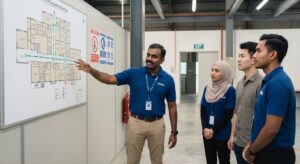
Therefore, the host organisation should provide a site briefing before work begins.
The briefing should explain emergency alarms, evacuation routes, restricted areas and permit-to-work requirements.
The responsible person should also confirm who issues the hot work permit and who closes it.
Using a contractor’s own safety procedure does not automatically remove the need to follow the host organisation’s site controls.
Both parties should agree on the process before work begins.
Hot Work and Fire Extinguishers
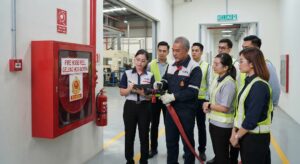
Suitable first-response firefighting equipment should remain accessible during hot work.
However, the organisation should select equipment based on the actual fire risks.
A dry powder or CO₂ extinguisher may suit some circumstances, while other environments may require different equipment.
Businesses should avoid placing an extinguisher at the worksite merely to satisfy a permit checkbox.
Workers need to know what the extinguisher can control and what its limitations are.
FERA’s fire extinguisher Malaysia guide explains common extinguisher types and their workplace applications.
If a fire grows beyond the capability of first-response equipment, employees should raise the alarm and evacuate.
PPE Does Not Replace Fire Prevention
Welders may use helmets, gloves, protective clothing and eye protection.
These controls protect the worker from several direct hazards.
However, PPE does not prevent sparks from igniting cardboard behind the work area.
Therefore, employers should not rely on PPE as the primary fire prevention method.
A safe hot work system needs several layers of control.
The organisation should first reduce the hazard where practical. It should then manage the area, equipment and working method before relying on personal protective equipment.
This approach protects both the person performing the work and other employees nearby.
Common Hot Work Permit Mistakes
One common weakness appears when businesses issue permits without inspecting the work area.
The form becomes paperwork rather than a safety control.
Another problem occurs when the permit remains valid even after conditions change. For example, another department may move combustible materials into the area after the original inspection.
Some workplaces also close the permit immediately when welding stops. This practice can overlook residual heat or hidden sparks.
Contractor management creates another common gap. The contractor may believe that the client manages fire safety, while the client assumes that the contractor controls the entire task.
Clear responsibilities prevent this confusion.
Finally, workers sometimes continue hot work after the permit expires because the task is nearly complete.
The team should stop and obtain the required extension or new authorisation instead.
Hot Work Permit and Fire Risk Assessment
The hot work permit manages a specific activity for a specific period.
A fire risk assessment looks more broadly at the organisation’s fire hazards and controls.
Businesses need both approaches.
For example, the fire risk assessment may identify welding as a significant ignition source within a workshop.
The organisation can then establish a permanent hot work procedure.
When an individual job occurs, the permit confirms that employees have applied the required controls to that specific task and location.
FERA’s Fire Risk Assessment Malaysia guide explains how organisations can identify and manage fire hazards systematically.
This connection helps turn risk assessment findings into practical daily controls.
Who Should Approve a Hot Work Permit?
The organisation should appoint authorised personnel through its own permit-to-work procedure.
The person issuing the permit needs enough knowledge to understand the hazards, inspect the area and verify that suitable controls exist.
The individual should also have enough authority to stop the job when conditions are unsafe.
The work supervisor carries a different responsibility.
The supervisor must ensure that employees follow the permit conditions throughout the job.
A company should avoid creating a system where one person signs every stage without meaningful verification.
Separating responsibilities can provide stronger checking, especially for higher-risk activities.
Training Employees for Hot Work Safety
Employees need training that reflects their responsibilities.
A welder requires technical competency in the task and equipment. A permit issuer needs to understand risk assessment and authorisation procedures.
Meanwhile, a fire watcher needs fire awareness, emergency communication skills and a clear understanding of when to escalate the incident.
Supervisors should understand all three perspectives.
Training should use practical workplace examples rather than relying only on generic slides.
Workers should be able to recognise combustible materials, unsafe gas cylinder arrangements, damaged equipment and unsuitable work locations.
FERA’s Basic Fire Safety training can support wider employee understanding of fire hazards, fire prevention and emergency response.
What to Do If a Fire Starts During Hot Work
Workers should stop the job and raise the alarm immediately when a fire develops beyond a safe initial response.
The organisation’s emergency plan should determine the next actions.
Employees who have appropriate training may use suitable firefighting equipment on a small, early-stage fire when they can maintain a safe escape route.
However, they should never allow firefighting attempts to delay evacuation.
The team should also isolate hot work equipment when safe to do so.
After evacuation, employees should report to the assembly point and provide relevant information to the emergency team.
A supervisor should tell responders where the hot work occurred, what materials were present and whether gas cylinders or other hazards remain nearby.
Reviewing the Permit After the Job
A completed hot work permit provides useful information for future safety improvements.
Management should review incidents, near misses and recurring problems.
For example, repeated findings involving combustible storage may indicate poor housekeeping rather than isolated hot work mistakes.
If employees repeatedly struggle to obtain suitable firefighting equipment, the organisation may need to improve equipment placement.
The company should also update its procedure after significant incidents or operational changes.
Permit systems work best when management treats them as active risk controls rather than documents created only for audits.
Build Safer Hot Work Practices with FERA
Hot work can form a normal part of maintenance, construction and industrial operations.
However, normal work can still create serious fire risk.
A structured hot work permit Malaysia process helps employers identify hazards before welding, cutting or grinding begins.
It also clarifies responsibilities, confirms fire precautions and ensures that the organisation checks the area again after the work finishes.
Effective control combines a suitable permit system with competent workers, good housekeeping, fire safety equipment and emergency preparedness.
FERA provides fire safety, firefighting, HAZMAT and Emergency Response Team training for organisations across Malaysia.
Explore FERA’s workplace safety training programmes or contact FERA to discuss training for maintenance teams, contractors and emergency responders.
Conclusion
A hot work permit should never become a simple form that employees sign before starting work.
Its purpose is to confirm that the organisation has identified the hazards and introduced suitable controls.
Employers should inspect the work area, remove combustible materials where practical, prepare appropriate firefighting equipment and assign clear responsibilities.
They should also monitor the area after the job finishes.
When management combines these controls with competent workers and practical fire safety training, hot work becomes easier to manage safely.
The objective is not to create unnecessary paperwork.
It is to prevent one welding spark, grinding particle or heated surface from becoming a workplace fire.
Frequently Asked Questions About Hot Work Permit Malaysia
What is a hot work permit?
A hot work permit is a written authorisation used to control activities that generate heat, sparks or flames. It records the work, hazards, precautions and responsible personnel before the activity begins.
What activities may require a hot work permit?
Depending on the workplace procedure and risk assessment, hot work may include welding, flame cutting, brazing, soldering, grinding and other activities that create significant heat or sparks.
Is a hot work permit required for every welding job?
Requirements depend on the workplace, activity and applicable safety arrangements. Organisations should use their risk assessment and permit-to-work procedure to determine when formal authorisation is necessary.
What is the purpose of a fire watcher?
A fire watcher monitors the surrounding area for sparks, smoke or signs of ignition while another employee performs the hot work. The person also helps raise the alarm if an emergency develops.
Should the permit close immediately after welding finishes?
Not necessarily. The responsible person should check the area and complete any required post-work monitoring before closing the permit.
Can contractors use their own hot work permit?
A contractor may have an internal system, but the contractor must also comply with the host organisation’s site procedures and agreed permit-to-work arrangements.
What firefighting equipment should be available during hot work?
The equipment should match the identified fire hazards. A risk assessment should determine the appropriate extinguisher or other fire protection equipment for the work area.
Does a hot work permit replace employee training?
No. A permit controls the job, but employees still need the competency and training required for their responsibilities.
Where can organisations arrange fire safety training?
Organisations can explore FERA’s training programmes for fire safety, firefighting, HAZMAT and Emergency Response Team development.