

Fire safety signage Malaysia workplaces use can make a major difference during an emergency.
When a fire alarm sounds, employees and visitors need to recognise escape routes, locate fire equipment and move towards the correct assembly point without confusion.
A sign may look simple during normal operations. However, during smoke, stress or crowd movement, clear signage helps people make faster and safer decisions.
Fire safety signage does not replace fire alarms, fire extinguishers, hose reels, fire doors or employee training. Instead, it supports these safety measures by making important locations easier to identify when time matters.
For workplaces, signage should not be treated as decoration or a last-minute compliance item.
It should form part of the organisation’s fire safety planning, workplace inspection and emergency response training.
Organisations can strengthen employee readiness through FERA’s fire safety and emergency response training programmes.
What Is Fire Safety Signage?
Fire safety signage refers to signs that guide people during a fire emergency and help them identify fire protection equipment.
These signs may indicate escape routes, emergency exits, fire extinguishers, hose reels, manual call points, assembly points and restricted fire safety areas.
A workplace may also use signs to warn employees about fire hazards, flammable materials, electrical rooms or areas where smoking is prohibited.
Good signage communicates information quickly.
Employees should not need to read a long paragraph during an emergency. Instead, they should be able to recognise the sign, understand the direction and take the correct action.
This is why the location, visibility, size, colour and wording of fire safety signs matter.
For official guidelines on workplace safety regulations, building owners can refer to the Jabatan Bomba dan Penyelamat Malaysia (JBPM) guidelines to ensure full compliance.
Why Fire Safety Signage Matters in the Workplace
During a fire emergency, people may feel stressed or confused.
Even employees who know the building may hesitate when smoke reduces visibility or when their normal route becomes blocked.
Visitors, contractors and new employees may face even greater difficulty because they may not know the building layout well.
Fire safety signage helps reduce this confusion.
It shows people where to go, what areas to avoid and where emergency equipment is located.
Clear signage also supports fire wardens and Emergency Response Team members. When employees can identify exit routes and assembly points quickly, wardens can focus on guiding movement and maintaining order.
Therefore, signage supports faster evacuation, better equipment visibility and stronger emergency coordination.
Proper placement and visibility of exit signs also align with international safety recommendations outlined by the Occupational Safety and Health Administration (OSHA) standards.
Fire Exit Signs
Fire exit signs guide occupants towards a safe escape route.
A fire exit sign should be visible from normal movement areas such as corridors, staircases, lobbies and work zones.
The sign should help people understand which direction to move when leaving the building.
A good fire exit sign should not be blocked by decorations, banners, furniture, stock, temporary partitions or open doors.
Management should also check that exit signs remain visible under different lighting conditions.
In some buildings, emergency lighting supports exit visibility during a power failure.
FERA has also covered common emergency exit safety issues in its workplace fire safety content. Organisations should review exit routes together with employee training and evacuation drills.

Fire Equipment Signs
Fire equipment signs help employees identify firefighting equipment quickly.
These may include signs for fire extinguishers, hose reels, fire blankets, manual call points and other emergency devices.
A fire extinguisher or hose reel may become less useful if employees cannot locate it quickly.
This is especially important in large workplaces, factories, warehouses and shared buildings where equipment may sit behind columns, inside cabinets or near busy operational areas.
Fire equipment signs should remain visible even after workplace layouts change.
For example, if management moves racks, desks or machinery, the sign should still direct employees towards the correct location.
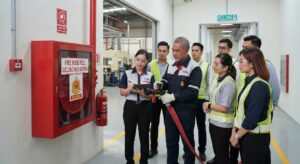
Employees can also learn more about safe hose reel use through FERA’s article, What Is a Fire Hose Reel and When Should It Be Used?. FERA’s existing guidance already positions hose reel use around safe workplace response rather than product supply or installation.
Manual Call Point Signs
A manual call point allows someone to activate the fire alarm after discovering a fire or serious fire-related hazard.
Employees should know where the nearest call point is located.
The sign should make the device easy to recognise during both normal work and an emergency.
If a call point is hidden behind stock, display items or temporary materials, employees may lose valuable time when they need to raise the alarm.
Management should also brief employees during induction and fire safety training.
A sign works best when employees already understand what the device does and when they should use it.
Assembly Point Signs
The assembly point sign shows where employees, visitors and contractors should gather after evacuation.
This location helps management conduct a headcount and confirm whether anyone may still be inside the building.
A clear assembly point sign reduces confusion after people leave the premises.
Without a clear location, employees may gather in different areas, leave the site too early or block emergency access routes.
The assembly point should be positioned at a safe location away from immediate fire and emergency response activities.
At the same time, it should remain practical for headcount management.
Management should review the assembly point whenever site layout, traffic flow or building access changes.
Fire Action Notices
A fire action notice explains the basic steps employees should follow during a fire emergency.
It may include instructions such as raising the alarm, contacting emergency services, leaving through the nearest safe exit and reporting to the assembly point.
The notice should use simple language.
Employees should not need to interpret complex instructions while an emergency is happening.
Fire action notices may be placed in lobbies, staff areas, workshops, training rooms, reception areas and near alarm points.
However, a notice alone is not enough.
Employees still need practical briefing and drills so they can apply the procedure correctly.
Signs for Fire Doors
Fire doors help limit the spread of fire and smoke when they are properly used and maintained.
Signs can remind employees to keep fire doors closed and avoid blocking them.
This is important because people may wedge fire doors open for convenience or place materials in front of them during daily operations.
A fire door sign reinforces the behaviour that management expects.
However, signage cannot solve the problem if the workplace culture allows fire doors to be misused.
Supervisors should correct poor habits quickly and include fire doors in regular workplace safety checks.
Signs for Fire Hazards
Some signs warn employees about areas or materials that may create additional fire risks.
These may include flammable liquid areas, electrical rooms, hot work zones, battery charging areas, chemical storage rooms and no-smoking zones.
The sign should match the actual hazard.
For example, a general warning sign may not provide enough information where employees handle specific chemicals or combustible materials.
In higher-risk areas, signage should support safe work procedures, hazard communication and suitable employee training.
Fire Safety Signage for Visitors and Contractors
Employees may know the workplace layout because they move through it every day.
Visitors and contractors do not have the same familiarity.
Therefore, signage is especially important in reception areas, meeting rooms, training centres, warehouses and contractor work zones.
A visitor should be able to identify a basic evacuation direction without needing to ask several people.
Contractors should also receive a site safety briefing when their work affects fire safety.
For example, workers performing hot work should know the nearest alarm point, firefighting equipment and escape route before the task begins.
Signage supports this briefing, but it should not replace it.
Fire Safety Signage in Factories and Warehouses
Factories and warehouses often have large floor areas, storage racks, machinery and moving vehicles.
Fire safety signs in these workplaces must remain visible despite operational activity.
A sign placed too low may be blocked by pallets.
A sign placed behind machinery may become difficult to see.
Likewise, a sign hidden by stock may not help anyone during an evacuation.
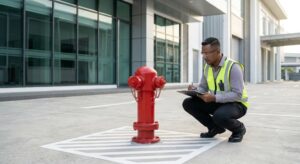
Management should review signs from the viewpoint of employees moving through the site.
Can employees see the sign from normal walking routes?
Can forklift activity block it?
Does the direction still make sense after a layout change?
Warehouse and factory teams should include signage in routine workplace inspections.
Fire Safety Signage in Offices and Commercial Buildings
Offices and commercial buildings may appear lower risk than industrial sites, but signage still matters.
Employees, tenants, clients and visitors may occupy different areas of the building.
People may use meeting rooms, shared corridors, lifts, staircases and parking areas.
Clear exit signs, assembly point signs and fire action notices help create a more organised evacuation.
Building management should also communicate fire safety arrangements to tenants.
In multi-tenant buildings, each tenant should understand the shared evacuation route and assembly point.
Good signage helps everyone follow the same direction during an emergency.
Fire Safety Signage in Training Centres and Public Facilities
Training centres, schools, hotels, event spaces and public facilities often welcome people who do not know the building.
This makes clear wayfinding even more important.
A visitor may not know where the staircase is located or which exit leads to the assembly point.
Emergency signs should therefore be clear, consistent and easy to understand.
Staff members should also know how to guide visitors calmly.
In these environments, signage works together with trained personnel and clear public instructions.
Common Fire Safety Signage Problems
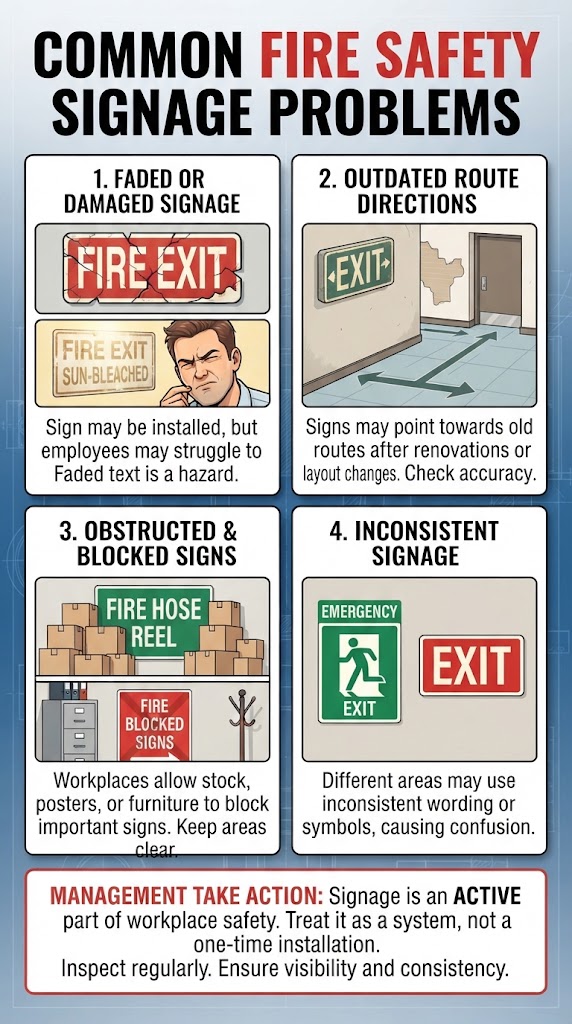
One common problem is faded or damaged signage.
A sign may still be installed, but employees may struggle to read it.
Another problem occurs when signs point towards an outdated route after renovation or layout changes.
Some workplaces also allow stock, posters or furniture to block important signs.
In other cases, different areas of the same building may use inconsistent wording or symbols.
This can cause confusion during a stressful situation.
Management should therefore treat signage as an active part of workplace safety rather than a one-time installation.
How Often Should Fire Safety Signage Be Checked?
Fire safety signage should be checked regularly as part of workplace inspections.
The inspection should confirm that signs remain visible, readable, accurate and relevant to the current workplace layout.
Signs should also be reviewed after renovation, office relocation, racking changes, machinery installation or changes to evacuation routes.
A sign that worked last year may no longer work after the building layout changes.
Facilities teams, safety personnel and fire wardens can help identify signage problems during routine operations and fire drills.
When a problem appears, management should correct it promptly.
Fire Safety Signage and Fire Drills
A fire drill gives management a practical opportunity to test whether signage works.
During a drill, observers can check whether employees follow the intended route, recognise exits and move towards the correct assembly point.
If employees hesitate or move in the wrong direction, signage may need improvement.
However, the problem may not always be the sign itself.
Employees may also need clearer training, better induction or stronger fire warden support.
The organisation should record these findings after the drill and assign corrective actions.
FERA’s existing Fire Drill Training Malaysia guide explains how workplace drills can identify problems involving evacuation routes, communication and employee response.
Signage and Emergency Lighting
Fire safety signs may become harder to see when smoke, poor lighting or power failure affects visibility.
Emergency lighting can support evacuation by illuminating escape routes, stairways and exits.
Management should not assume that a sign remains useful under all conditions simply because it looks clear during normal business hours.
The organisation should consider how the sign may perform during a real emergency.
This is particularly important for basements, enclosed corridors, windowless rooms and large industrial areas.
A workplace inspection should therefore consider signage and emergency lighting together.
Fire Safety Signage and Employee Training
Signs help people recognise what to do, but training helps them understand why it matters.
Employees should understand the meaning of exit signs, fire equipment signs, alarm points and assembly point signs.
They should also understand when they should use firefighting equipment and when evacuation should take priority.
For example, seeing a fire extinguisher sign does not mean every employee should attempt to fight a fire.
Training helps employees make safer decisions.
FERA provides workplace fire safety and emergency response training for organisations that want to improve employee awareness and readiness.
Who Should Manage Fire Safety Signage?
Fire safety signage should have clear ownership.
In some organisations, facilities teams manage signs, lighting and building layout.
In others, safety personnel conduct inspections and recommend corrective actions.
Fire wardens may also report blocked or unclear signs during drills and daily operations.
The strongest approach is shared responsibility with clear coordination.
Facilities personnel can maintain the physical signs.
Safety personnel can review whether the signs support the emergency plan.
Department supervisors can make sure daily work activities do not block them.
Fire Safety Signage and Emergency Response Teams
An Emergency Response Team should know the location of important signs and emergency equipment.
During an emergency, the team may guide employees, visitors or external responders through the premises.
Clear signage supports this role.
For example, equipment signs help responders identify extinguishers, hose reels, manual call points and other emergency locations more quickly.
The ERT should report any sign that is missing, damaged, blocked or misleading.
FERA’s Emergency Response Team programmes include workplace emergency preparedness, evacuation, firefighting and response roles at different training levels.
What Businesses Should Do Before Installing New Signs
Before installing new fire safety signs, management should review the actual workplace layout.
The organisation should identify evacuation routes, equipment locations, assembly points and areas where people may become confused.
It should also consider visitors, contractors, shift workers and employees who may have limited familiarity with the site.
After installation, management should walk through the route and check the signs from a user’s perspective.
A sign may look correct on a plan but fail during real movement.
This practical walkthrough can help the organisation improve sign placement before an emergency happens.
Why Consistency Matters
Signs should follow a consistent style across the workplace.
If one floor uses different symbols, colours or wording from another floor, employees may hesitate.
Consistency is especially important in larger buildings, multiple branches or industrial facilities with several zones.
Management should avoid mixing old and new signs in a way that creates confusion.
When upgrading signage, the organisation should plan the change properly and remove outdated signs.
Clear and consistent signage helps support confident evacuation.
To maintain clarity during emergencies, organizations should adopt internationally recognized symbols compliant with ISO 7010 safety sign standards.
Fire Safety Signage and Workplace Culture
Signage can also show whether an organisation takes fire safety seriously.
When signs are clean, visible and respected, employees receive a clear message that workplace safety matters.
When signs are faded, blocked or ignored, employees may begin treating fire safety as unimportant.
Workplace culture appears in small daily actions.
Do employees block fire equipment signs with stock?
Do supervisors correct the issue?
Do maintenance teams report damaged signs?
Do managers follow up on corrective actions?
These behaviours determine whether signage remains useful beyond the day it was installed.
Build Better Fire Readiness with FERA
Fire safety signage Malaysia workplaces use should help people move, act and respond clearly during an emergency.
Good signage supports evacuation, equipment visibility, assembly point control and emergency communication.
However, signs work best when employees understand the emergency plan and practise their response.
Businesses should inspect signs regularly, update them after layout changes and include signage observations during fire drills.
FERA provides workplace fire safety, firefighting, fire warden and Emergency Response Team training for organisations that want to strengthen employee readiness.
Explore FERA’s training programmes to identify a suitable programme for your workplace.
Conclusion
Fire safety signage is a simple but important part of workplace emergency readiness.
It helps employees, visitors and contractors identify exits, alarm points, fire equipment and assembly areas when they need to act quickly.
However, signage must remain visible, accurate and supported by training.
A fire exit sign hidden behind storage or a hose reel sign pointing towards blocked equipment will not help during an emergency.
Management should therefore inspect signs regularly, correct problems quickly and review signage after workplace layout changes.
When signage, training and emergency procedures work together, the organisation becomes better prepared to protect people during a fire.
Organisations that want to strengthen employee fire safety awareness can contact FERA Training Center to discuss suitable workplace training.
Questions & Answers
What is fire safety signage?
Fire safety signage refers to signs that identify exits, escape routes, fire equipment, alarm points, assembly points and fire-related hazards.
Why is fire safety signage important?
It helps employees, visitors and contractors recognise where to go, what to avoid and where emergency equipment is located during a fire emergency.
What are common types of fire safety signs?
Common signs include fire exit signs, fire extinguisher signs, hose reel signs, manual call point signs, assembly point signs and fire action notices.
Should fire safety signs be checked regularly?
Yes. Signs should remain visible, readable, accurate and free from obstruction.
Can signage replace employee training?
No. Signage supports emergency response, but employees still need training so they understand evacuation procedures, alarm signals and safe actions.
When should fire safety signage be updated?
Signage should be reviewed after renovations, layout changes, new equipment installation, evacuation route changes or fire drill findings.
Who should manage fire safety signage?
Facilities teams, safety personnel, fire wardens and management should work together to inspect and maintain workplace fire safety signage.
Where can companies arrange fire safety training?
Companies can explore FERA’s fire safety and emergency response training programmes or contact FERA directly for workplace training options.