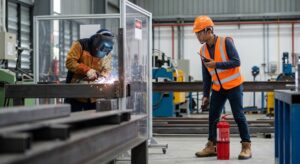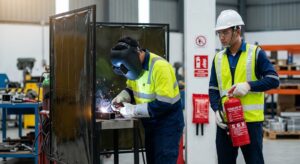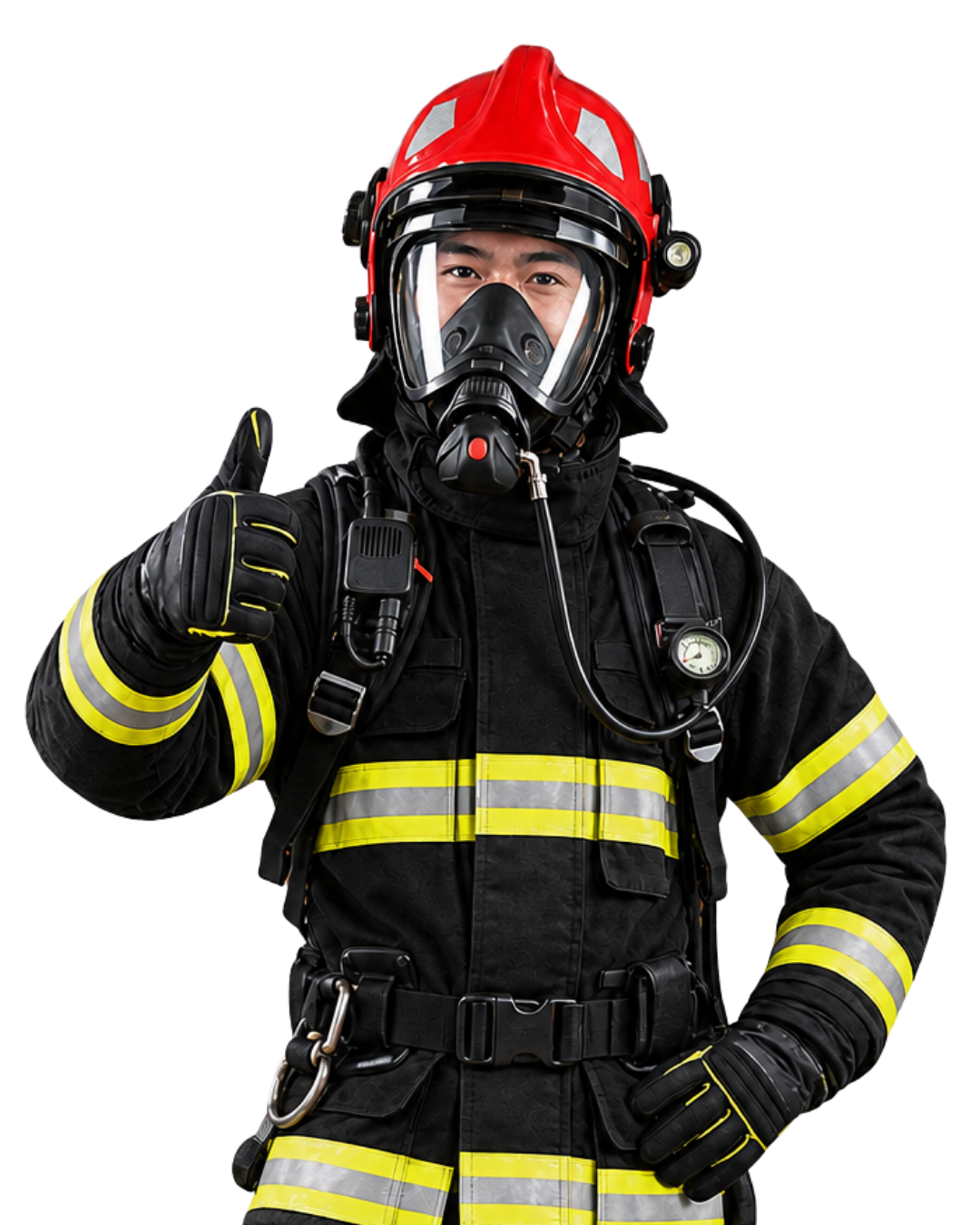


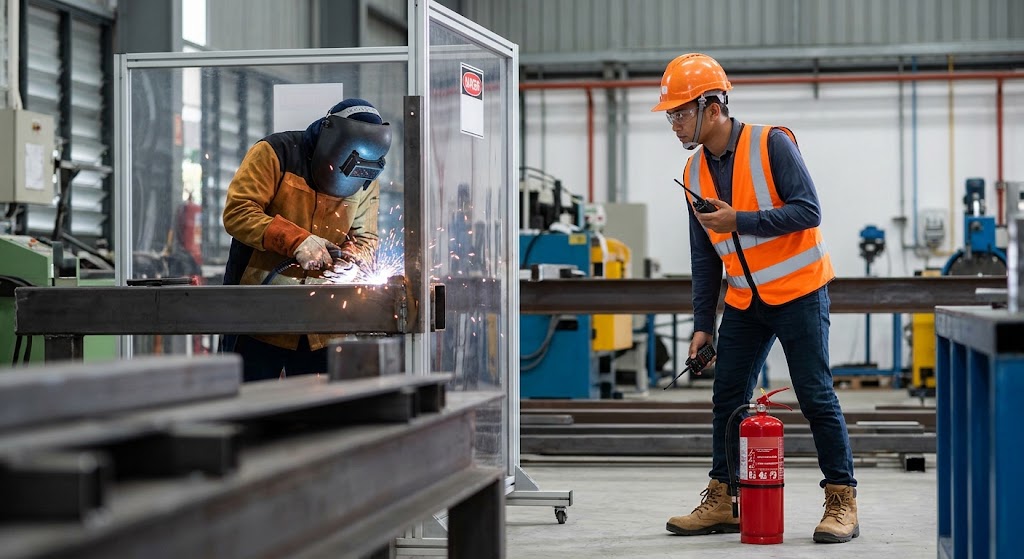
A fire watcher Malaysia workplace appoints plays an important role when welding, cutting, grinding or other hot work creates a potential ignition source.
The person does not simply stand beside the worker with a fire extinguisher. A fire watcher needs to observe the work area continuously, identify changing conditions and act quickly when sparks, heat or smoke create an unsafe situation.
This role becomes especially important in factories, construction sites, plants, maintenance areas and confined spaces where hot work may take place near combustible materials or hazardous processes.
A competent fire watcher should understand basic fire behaviour, workplace alarm procedures and the limits of first-response firefighting.
Organisations that conduct regular hot work should therefore include fire watch arrangements within their wider fire prevention and emergency response system.
What Is a Fire Watcher?
A fire watcher is a person assigned to monitor activities that may create a fire hazard.
Hot work provides the most common example. Welding and cutting can release sparks, molten metal and intense heat. Grinding may also send hot particles away from the immediate work area.
The person performing the task may concentrate heavily on the welding point or equipment. As a result, the worker may not notice a spark entering a gap, landing behind machinery or igniting material outside the immediate field of view.
The fire watcher provides an additional layer of observation.
Malaysia’s Department of Occupational Safety and Health recognises the fire watch role within its guidance for hazardous work activities.
Employers can refer to the official DOSH guidance on safe working in confined spaces.
Why Does Hot Work Need a Fire Watcher?
Hot work can create ignition sources beyond the area that the worker can see.
A welding spark may travel behind equipment. Heated metal can transfer heat through a partition. Molten particles may also fall through floor openings and reach combustible materials on another level.
These hazards explain why watching only the welding point is not enough.
The fire watcher monitors the wider environment while the authorised worker performs the task.
The person should pay attention to:
- Unusual smoke
- Burning smells
- Sparks travelling outside the controlled area
- Changes to nearby work activities
- Combustible materials entering the work area
- Signs of heat spreading beyond the work location
For example, another team may move cardboard, chemicals or other combustible materials into an area that was clear when the work started.
When conditions change, the fire watcher should raise the concern and stop the activity when necessary.
Fire Watcher and Hot Work Permit: What Is the Difference?
A hot work permit and a fire watcher perform different functions.
The permit provides formal authorisation for the activity. It records the location, type of work, hazards, precautions and responsible personnel.
The fire watcher actively monitors the worksite while the authorised activity takes place.
In simple terms, the permit establishes the controls while the fire watcher helps ensure that those controls remain effective.
A workplace may therefore use both controls together.
The permit issuer can confirm that:
- Combustible materials have been removed
- Suitable firefighting equipment remains available
- The work area has been assessed
- Emergency arrangements are understood
- A competent fire watcher has been appointed
The watcher then monitors whether those conditions remain safe throughout the work.
What Are the Main Fire Watcher Responsibilities?
A fire watcher should understand the activity before work begins.
The person needs to know where sparks may travel, what materials surround the area and how to raise the alarm if something goes wrong.
During hot work, the fire watcher should maintain continuous observation instead of becoming involved in unrelated activities.
Typical responsibilities may include:
- Monitoring the hot work area
- Monitoring nearby and adjacent spaces
- Watching for sparks, smoke or signs of ignition
- Checking whether conditions change
- Keeping firefighting equipment accessible
- Maintaining communication with the hot work team
- Stopping work when conditions become unsafe
- Raising the alarm when necessary
- Monitoring the area after work ends
This responsibility makes fire watching part of fire prevention rather than simply emergency firefighting.
Can a Fire Watcher Perform Other Work at the Same Time?
Employers should avoid assigning additional duties that prevent the fire watcher from monitoring the area properly.
For example, the person should not perform welding, operate machinery or repeatedly leave the area while hot work continues.
The value of a fire watcher comes from maintaining attention on the conditions surrounding the activity.
If the employee needs to leave, another competent person should take over the role before work continues.
This becomes especially important during longer maintenance activities and shift changes.
The work should not continue when nobody is actively performing the fire watch responsibility.
What Should Be Checked Before Hot Work Starts?
Before work begins, the fire watcher should understand the site controls and take part in the pre-work inspection where required.
Workers should remove unnecessary combustible materials from the surrounding area.
They should also consider openings, partitions and spaces behind equipment where sparks could travel unnoticed.
Before the work begins, check whether:
- Combustible materials have been removed or protected
- Nearby areas are free from unnecessary fire hazards
- Openings where sparks may travel have been considered
- Suitable firefighting equipment is accessible
- The alarm activation method is known
- The evacuation route is clear
- Communication methods are working
- The hot work permit has been authorised
- The fire watcher understands the assigned role
The organisation should resolve significant problems before work begins rather than expecting the fire watcher to compensate for poor preparation.
Fire Watcher Training in Malaysia
A person needs suitable knowledge before accepting fire watch responsibilities.
Training should help the employee understand:
- Basic fire behaviour
- Hot work hazards
- Fire prevention
- Fire extinguisher awareness
- Emergency communication
- Alarm procedures
- Stop-work authority
- Post-work monitoring
Employees working around confined spaces may require additional competency because those environments introduce further hazards such as restricted access and hazardous atmospheres.
NIOSH Malaysia provides Fire Watcher Safety training that covers responsibilities, fire theory, fire extinguisher awareness and practical activities.
Official NIOSH course information, click pdf here.
However, employers should also provide site-specific information.
A training course alone cannot teach the employee where the workplace alarm is located, which emergency number to call internally or what hazards exist beside a particular maintenance area.
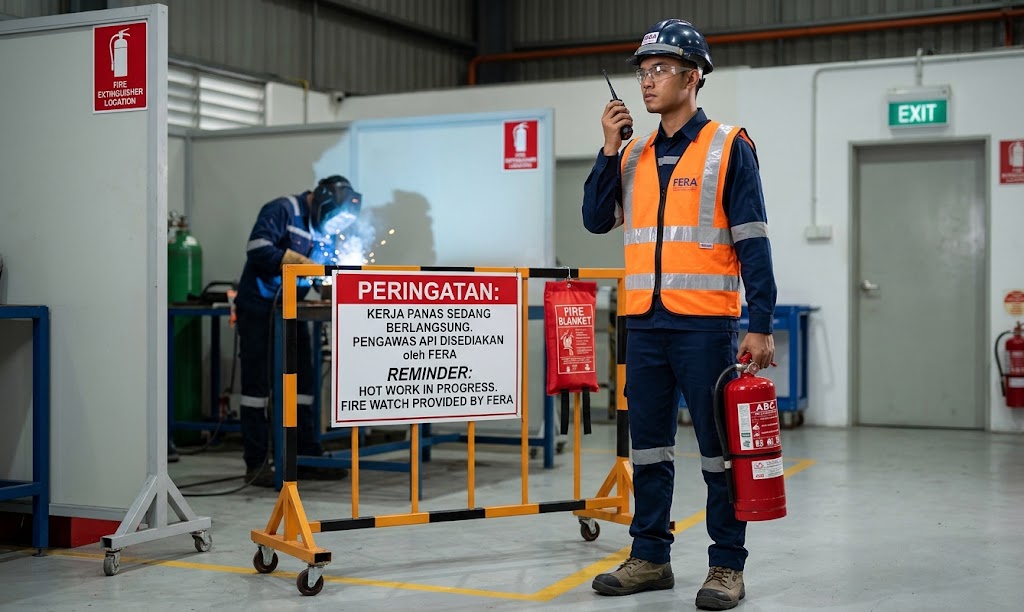
Basic Firefighting Knowledge for Fire Watchers
A fire watcher should understand how a fire develops and how quickly conditions can change.
The person should recognise the difference between a small early-stage incident and a fire that requires immediate evacuation.
Fire extinguisher awareness also matters.
Different extinguishing agents suit different hazards. Using unsuitable equipment may increase danger or cause additional damage.
However, a fire watcher should never believe that the role requires fighting every fire.
Early detection, alarm activation and safe escalation remain the priorities.
When conditions become unsafe, the person should raise the alarm and follow the emergency procedure instead of attempting actions beyond their competency.
FERA provides Basic Fire Safety training for organisations that want to strengthen practical employee awareness.
When Should a Fire Watcher Stop Hot Work?
The fire watcher should take action when conditions no longer match the approved safe working arrangement.
Examples include:
- Combustible materials entering the work area
- Firefighting equipment becoming unavailable
- A possible flammable atmosphere being identified
- Ventilation becoming inadequate
- Equipment becoming damaged
- Sparks travelling beyond the controlled area
- An emergency developing nearby
- Communication being lost
- The fire watcher being unable to maintain observation
A fire watcher should not feel pressured to let the job continue simply because stopping the work may delay maintenance.
The organisation should provide clear stop-work authority.
Employees should know that they can stop unsafe hot work without waiting for an actual fire.
Fire Watcher Duties After Hot Work
Fire risk does not always disappear when workers switch off welding or cutting equipment.
Hot metal can retain heat.
Sparks may remain inside hidden spaces.
Combustible materials can also smoulder before producing visible flames.
Therefore, workplaces should establish a post-work monitoring procedure.
The fire watcher should inspect:
- The immediate work area
- Areas behind equipment
- Nearby partitions
- Floor openings
- Lower levels where sparks may have fallen
- Nearby combustible materials
- Hidden spaces where heat may remain
The permit should remain open until the organisation completes the required checks.
The appropriate monitoring period depends on the risk, workplace procedure and applicable requirements.
Higher-risk areas may require longer observation or repeated inspections.
Fire Watcher Duties in Confined Spaces
Hot work inside a confined space requires additional controls.
A tank, vessel, pit or similar location may contain hazardous atmospheres and restricted escape routes.
Therefore, a hot work permit alone may not provide enough protection.
The workplace may also require:
- Confined-space entry controls
- Atmospheric monitoring
- Ventilation
- Communication
- Rescue arrangements
- Suitable PPE
- Competent entry personnel
Employees should never assume that welding inside a confined space is simply normal hot work performed in a smaller area.
FERA provides Rescue in Confined Space training for organisations that require practical emergency response capabilities.
Fire Watcher vs Standby Person
A fire watcher and a confined-space standby person perform different functions.
The fire watcher concentrates on fire and hot work hazards.
A standby person supports confined-space entry control, communication and emergency procedures.
Depending on the worksite and applicable competency requirements, one person may not be able to perform both responsibilities effectively at the same time.
Management should define the roles clearly before work begins.
Fire Watcher vs Fire Warden
A fire watcher also differs from a fire warden.
While a fire watcher monitors specific hazardous tasks such as welding, cutting, or grinding, a fire warden supports building evacuation and occupant movement during an emergency.
Both roles support fire safety, but they operate at different stages of the emergency process.
Employees appointed to evacuation duties can strengthen their competency through FERA Fire Warden training.
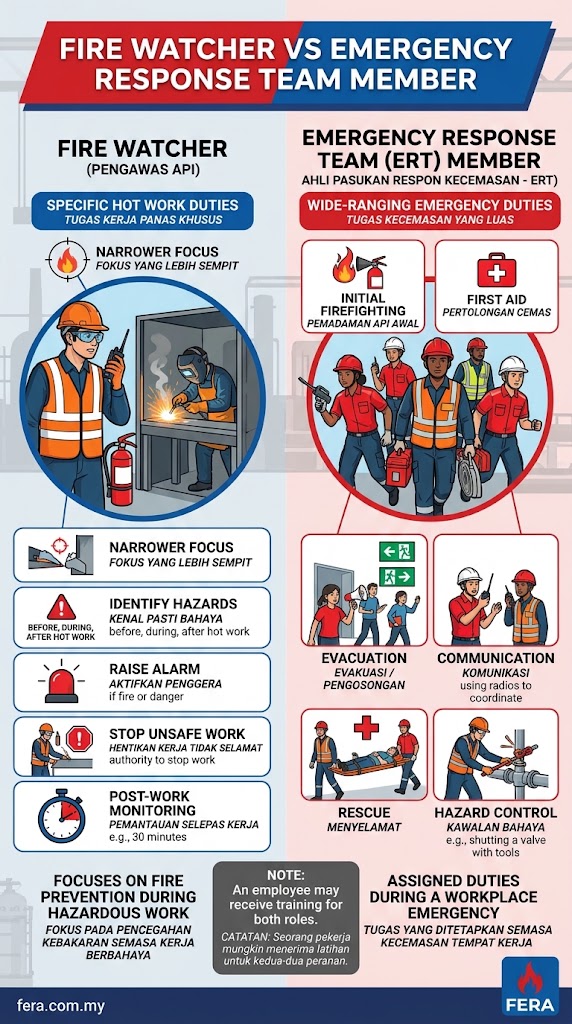
Fire Watcher vs Emergency Response Team Member
An Emergency Response Team member may perform several assigned duties during a workplace emergency.
These can include:
- Initial firefighting
- First aid
- Evacuation
- Communication
- Rescue
- Hazard control
A fire watcher normally has a narrower responsibility linked to a specific hazardous activity.
An employee may receive training for both roles.
However, management should still define which responsibility applies during each stage of the work.
FERA provides Emergency Response Team and workplace emergency training programmes.
Why Communication Matters
A fire watcher needs a reliable way to communicate with the worker performing hot work.
The watcher should be able to tell the worker to stop immediately when conditions become unsafe.
The person should also know how to contact the supervisor or activate the workplace alarm.
Large industrial facilities may use two-way radios.
Smaller workplaces may rely on direct communication and nearby alarm points.
Whatever method the organisation uses, employees should confirm that it works before starting high-risk work.
Poor communication can allow a manageable hazard to develop into a more serious emergency.
Contractors and Fire Watch Responsibilities
Contractors frequently perform welding, cutting and grinding during maintenance, installation and repair work.
The host organisation should not assume that every contractor understands the site’s fire watch requirements.
Before work begins, both parties should agree on:
- Who appoints the fire watcher
- Who issues the hot work permit
- Who checks the work area
- Who provides firefighting equipment
- Who controls site access
- Who confirms the area is safe afterwards
The contractor should also receive information about:
- Emergency alarms
- Evacuation routes
- Restricted areas
- Site hazards
- Emergency contacts
A contractor may understand welding very well while knowing very little about the client’s building or processes.
Good coordination between both parties reduces this gap.
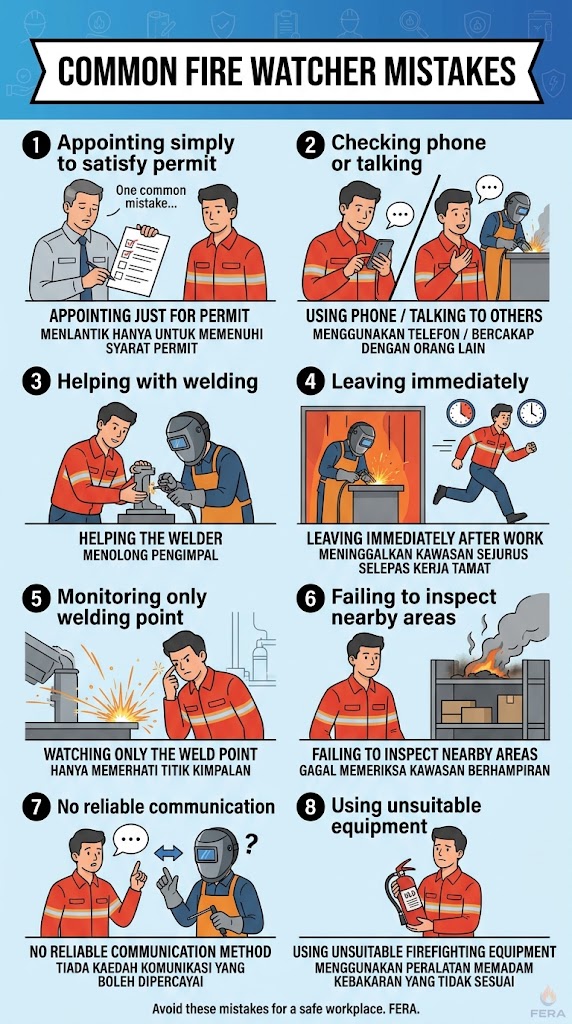
Common Fire Watcher Mistakes
One common mistake involves appointing a fire watcher simply to satisfy a permit requirement.
A person who spends the entire activity checking a phone, talking to other employees or helping with the welding cannot properly monitor the wider area.
Other common mistakes include:
- Leaving immediately after hot work finishes
- Monitoring only the welding point
- Failing to inspect nearby areas
- Having no reliable communication method
- Using unsuitable firefighting equipment
- Allowing combustible materials into the area
- Giving the fire watcher unrelated duties
- Failing to provide stop-work authority
A strong fire watch process requires competent observation, suitable emergency equipment and post-work monitoring.
Does Every Hot Work Activity Need a Fire Watcher?
Not every activity or workplace presents the same level of fire risk.
The organisation should determine the need for a fire watcher through its risk assessment, permit-to-work procedure and applicable requirements.
A permanent welding bay designed specifically for hot work may have different controls from temporary welding performed inside a warehouse.
Confined spaces and locations containing significant combustible materials usually require greater attention.
Management should assess the actual risk instead of making the decision purely for convenience.
How Employers Can Improve Fire Watch Arrangements
Employers should clearly define when the organisation requires a fire watcher.
The procedure should explain:
- Competency requirements
- Responsibilities
- Stop-work authority
- Communication methods
- Firefighting equipment
- Permit controls
- Post-work monitoring
Management should then support the system with suitable practical training.
Employees need to recognise hazards within real workplace situations instead of memorising definitions only.
Supervisors should also review fire watch performance during maintenance activities.
If the same problems continue appearing, the organisation should improve the procedure rather than simply reminding workers to be more careful.
Official fire safety information from the Fire and Rescue Department of Malaysia is available here.
Build Stronger Hot Work Fire Safety with FERA
A fire watcher can provide an important layer of protection during welding, cutting, grinding and other hot work.
However, the role only works when the appointed person understands the hazards, remains focused and has clear authority to act.
Organisations should support fire watchers through an effective permit-to-work system, suitable firefighting equipment and site-specific emergency procedures.
FERA provides practical fire safety, firefighting, HAZMAT, Fire Warden and Emergency Response Team training for Malaysian organisations.
Explore FERA’s fire safety and emergency training programmes.
Or contact FERA to discuss workplace training requirements.
Conclusion
A fire watcher Malaysia workplace appoints should never become a passive observer.
The role requires continuous attention before, during and after hazardous hot work.
A competent fire watcher should recognise unsafe conditions, communicate quickly and understand when the activity must stop.
The employee also needs enough fire safety knowledge to identify an early-stage incident without attempting actions beyond their competency.
When employers combine competent fire watchers with hot work permits, good housekeeping and emergency planning, they reduce the chance that a single spark develops into a serious workplace fire.
Frequently Asked Questions About Fire Watcher Malaysia
What does a fire watcher do?
A fire watcher monitors hot work and surrounding areas for sparks, smoke, heat or signs of ignition.
The person also raises the alarm or stops the activity when conditions become unsafe.
Does a fire watcher need training in Malaysia?
Training requirements depend on the workplace and type of activity.
Employees should receive suitable fire safety knowledge and any additional competency required for specialised environments such as confined spaces.
Is a fire watcher the same as a fire warden?
No.
A fire watcher monitors hazardous work such as welding or cutting, while a fire warden mainly supports evacuation and occupant management during an emergency.
Can the welder also act as the fire watcher?
The person performing hot work may not be able to continuously monitor the surrounding area.
Employers should assess the risk and appoint a separate competent fire watcher where required.
Does the fire watcher remain after welding finishes?
The workplace procedure should specify post-work monitoring.
Fire risk may remain after visible hot work stops because hot surfaces or hidden sparks can continue creating an ignition hazard.
What equipment should a fire watcher have?
The required equipment depends on the worksite risk assessment.
Suitable firefighting equipment, communication methods and relevant personal protective equipment should be available.
Can a fire watcher enter a confined space?
Only when the employee meets the relevant confined-space competency, entry and permit requirements.
Confined-space hot work requires additional controls beyond normal fire watch duties.
Where can employers arrange practical fire safety training?
Employers can review FERA’s fire safety and emergency response training programmes: