


How Often Should Fire Extinguishers Be Serviced?
Fire extinguishers are often the first line of defence when a small fire breaks out. However, simply having an extinguisher on the premises does not guarantee that it will work during an emergency. It must be inspected regularly, professionally serviced and recharged or replaced whenever necessary.
So, how often should fire extinguishers be serviced? As a practical fire-safety rule, portable fire extinguishers should receive a visual inspection at least once a month and a detailed maintenance service by a competent fire-protection service provider at least once a year. Additional servicing may be required after use, when damage is found or according to the extinguisher type, manufacturer’s instructions and applicable local requirements.
For businesses and building owners in Malaysia, servicing arrangements should also follow current requirements set by the Fire and Rescue Department of Malaysia (JBPM/BOMBA) and other standards applicable to the premises.
Fire Extinguisher Inspection vs Servicing: What Is the Difference?
The terms “inspection” and “servicing” are sometimes used interchangeably, but they refer to different activities.
Monthly visual inspection
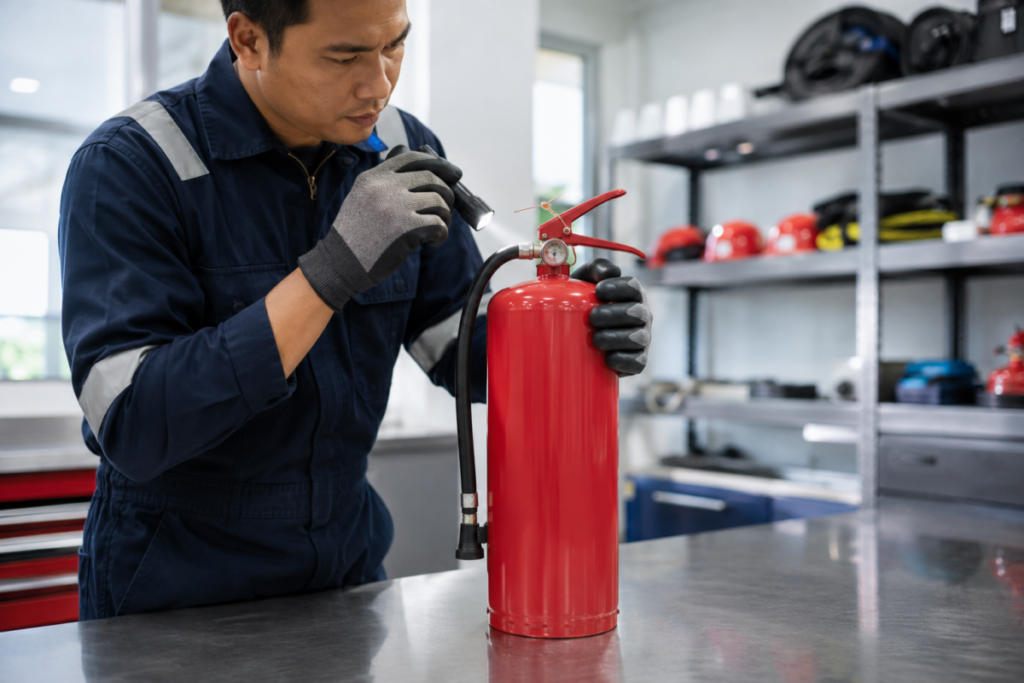
A monthly inspection is a quick visual and physical check to confirm that an extinguisher remains accessible and appears ready for use. This check may be carried out by a designated employee, safety representative, fire warden, Emergency Response Team member or another authorised person who understands what to look for.
The monthly check should confirm that:
- The extinguisher is in its designated location.
- It is visible and not blocked by furniture, stock or equipment.
- The operating instructions are readable and face outward.
- The safety pin and tamper seal are intact.
- The pressure gauge, where fitted, is within the normal operating range.
- The hose and nozzle are not cracked, blocked or damaged.
- The cylinder has no visible corrosion, leakage, dents or other damage.
- The extinguisher does not appear to have been discharged.
- The inspection tag or record has been updated.
Any extinguisher that fails this check should be reported and assessed promptly. It should not remain in service if there is doubt about its condition or reliability.
Annual professional servicing
Annual servicing is a more detailed maintenance procedure carried out by trained and competent personnel. Depending on the extinguisher type and condition, the technician may examine the cylinder, pressure, valve, hose, nozzle, safety devices, extinguishing agent, markings and maintenance history.
The service provider should identify whether the unit can remain in service or requires recharging, repair, testing or replacement. The service date and relevant maintenance details should also be properly recorded.
How Often Should Different Fire Extinguisher Checks Be Done?
The following schedule provides a practical overview. Exact requirements can vary according to the extinguisher manufacturer, hazard level, site conditions, adopted standard and local authority requirements.
| Activity | Recommended frequency | Who should perform it? |
|---|---|---|
| Routine observation | During normal workplace checks | Employees or responsible personnel |
| Formal visual inspection | At least monthly | Designated and instructed personnel |
| Detailed maintenance service | At least annually | Competent fire-protection service provider |
| Recharge | Immediately after any use or loss of charge | Competent service provider |
| Internal examination | At the interval specified for the extinguisher type | Competent service provider |
| Hydrostatic testing | At the interval applicable to the cylinder and extinguisher type | Qualified personnel using suitable equipment |
| Replacement | When damaged, unsafe, obsolete or beyond economical repair | On advice from a competent service provider |
High-risk environments may require more frequent inspections. Examples include construction sites, factories, commercial kitchens, marine environments, dusty areas, outdoor locations and premises where extinguishers are exposed to vibration, chemicals, moisture or extreme temperatures.
When Should a Fire Extinguisher Be Serviced Immediately?
Do not wait for the next annual service if an extinguisher may no longer be dependable. Arrange an immediate professional check when any of the following occurs.
After the extinguisher has been used
An extinguisher should be serviced after any use even if it was discharged for only a few seconds. Partial discharge can reduce pressure, affect the sealing surfaces or leave insufficient extinguishing agent for the next emergency.
The extinguisher must be recharged or replaced before being returned to its designated location.
When the pressure gauge is outside the normal range
For extinguishers fitted with a pressure gauge, a reading outside the normal operating zone can indicate that the unit is undercharged or overpressurised. Both conditions require professional attention.
A normal gauge reading alone does not prove that an extinguisher is fully functional. The cylinder, extinguishing agent, hose, valve and other components must also be in serviceable condition.
When the pin or tamper seal is missing
A missing pin or broken tamper seal may indicate that the extinguisher has been handled or used. The unit should be examined to confirm that it remains fully charged and safe.
When there is visible corrosion or physical damage
Rust, deep scratches, dents, leakage, damaged threads or exposure to fire can weaken an extinguisher cylinder. A damaged cylinder can be dangerous, especially because it is pressurised.
Do not attempt to repair or test a damaged extinguisher without the proper training and equipment. Isolate it safely and contact a competent service provider.
When the hose or nozzle is blocked or damaged
An extinguisher may contain sufficient agent and pressure but still fail if its discharge path is blocked. Insects, dirt, hardened extinguishing agent and physical damage can prevent proper discharge.
When the service label has expired or is unreadable
If the maintenance record is missing, expired or cannot be verified, arrange an inspection rather than assuming that the extinguisher is compliant.
Why Is Regular Fire Extinguisher Servicing Important?
Fire extinguisher maintenance is not only an administrative task. It helps ensure that the equipment can operate safely and effectively when someone needs it most.
It detects problems before an emergency
Loss of pressure, corrosion, blocked nozzles, damaged seals and incorrect placement can easily go unnoticed without routine checks. Early detection gives the organisation time to correct the issue before a fire occurs.
It supports workplace fire-safety readiness
Reliable equipment is one part of a complete fire-safety system. Employees must also know how to raise the alarm, evacuate safely and use an extinguisher only when the fire is small, they have been trained, the correct extinguisher is available and a safe escape route remains behind them.
Employers can strengthen these skills through firefighting and HAZMAT training and suitable practical exercises.
It supports inspection and recordkeeping
Clear inspection and servicing records help building management demonstrate that fire-safety equipment is being monitored. Records also allow the responsible person to identify recurring defects and plan replacements.
It protects people, property and business operations
An extinguisher failure can allow a controllable fire to grow rapidly. Proper inspection, maintenance and staff training reduce avoidable risk to occupants, equipment, stock and business continuity.
What Happens During Annual Fire Extinguisher Servicing?
The exact process depends on the extinguisher type and applicable maintenance requirements. A competent technician will generally:
- Confirm the extinguisher type, rating and suitability for its location.
- Check the cylinder for corrosion, dents, leakage or other damage.
- Examine the pressure indicator or verify the extinguisher’s charge.
- Inspect the handle, valve, pin, tamper seal, hose and nozzle.
- Check that operating instructions and labels are present and readable.
- Review whether internal maintenance or hydrostatic testing is due.
- Recharge, repair, condemn or replace the unit where necessary.
- Record the completed maintenance and next required action.
Where extinguishers are temporarily removed for servicing, the premises should maintain suitable fire protection rather than leaving the affected area unprotected.
Does a Fire Extinguisher Need to Be Recharged Every Year?
Not necessarily. Annual servicing and recharging are not the same thing.
An extinguisher must be professionally serviced at the required interval, but it is normally recharged when it has been used, has lost pressure, has been opened for certain maintenance procedures or is otherwise found to require recharging.
Never rely on the gauge alone or attempt to refill an extinguisher yourself. Recharging requires the correct extinguishing agent, equipment, procedures and verification.
How Long Does a Fire Extinguisher Last?
There is no single expiry age that applies to every fire extinguisher. Its service life depends on the extinguisher type, cylinder construction, manufacturer’s instructions, maintenance history, environmental exposure and physical condition.
An older extinguisher may remain serviceable if it passes all applicable inspections, maintenance and testing requirements. Conversely, a newer extinguisher may need immediate replacement if it is badly corroded, damaged, leaking, recalled or unsuitable for the hazard.
A competent service provider should determine whether the extinguisher can remain in service.
Who Is Responsible for Fire Extinguisher Maintenance?
The building owner, employer, occupier or designated responsible person should ensure that extinguishers are properly located, routinely inspected and professionally maintained. Individual responsibilities should be clearly assigned instead of assuming that someone else has completed the check.
A simple workplace system can include:
- An updated extinguisher inventory with identification numbers and locations.
- A monthly inspection checklist.
- A schedule for annual servicing and required testing.
- A process for immediately reporting damaged or discharged units.
- Records of servicing, recharge, testing and replacement.
- Employee training in alarm, evacuation and safe extinguisher use.
For wider workplace preparedness, explore FERA’s available fire-safety courses or learn more about basic firefighting and rescue principles.
Frequently Asked Questions
How often should workplace fire extinguishers be checked?
They should receive a formal visual inspection at least once a month and professional maintenance at least annually. More frequent checks may be necessary in high-risk or harsh environments.
Must a fire extinguisher be serviced after use?
Yes. Any extinguisher that has been fully or partially discharged should be removed from normal service and professionally recharged or replaced before it is relied upon again.
Can employees carry out fire extinguisher servicing?
Employees who have been properly instructed may carry out routine visual checks. Detailed maintenance, recharge, internal examination and pressure testing should be performed only by competent personnel with appropriate equipment.
What should I do if an extinguisher is damaged?
Do not use or tamper with a damaged pressurised cylinder. Report it, safely remove it from normal availability where appropriate and arrange an assessment by a competent service provider. Ensure suitable replacement protection is available.
Is annual servicing enough for every workplace?
Annual professional servicing does not replace monthly visual inspections. Sites with severe environmental conditions, frequent equipment movement or higher fire risks may require inspections more often than once a month.
Keep Your Team Ready to Respond
A serviced fire extinguisher is essential, but equipment alone is not enough. Your employees should understand fire hazards, know when an extinguisher can be used safely and recognise when evacuation is the only appropriate action.
FERA Training Center provides professional fire-safety, firefighting and emergency-response training for organisations and individuals in Malaysia. Our programmes combine essential knowledge with practical exercises to help participants respond more confidently and safely.
Strengthen your workplace fire preparedness today. Contact FERA Training Center to discuss a suitable fire-safety or practical firefighting training programme for your team.
Internal Link Plan
| Anchor text | Destination |
| firefighting and HAZMAT training | https://fera.com.my/firefighting-hazmat/ |
| FERA’s available fire-safety courses | https://fera.com.my/all-courses/ |
| basic firefighting and rescue principles | https://fera.com.my/basic-theory-of-firefighting-and-rescue/ |
| Contact FERA Training Center | https://fera.com.my/contact/ |
Recommended CTA Button
Button text: Enquire About Fire Safety Training
Button URL: https://fera.com.my/contact/
Editorial Note
Before publication, have a qualified Malaysian fire-protection professional confirm any servicing, registration or testing statement against the extinguisher manufacturer’s instructions and the latest requirements applicable to the premises. Monthly inspection and annual maintenance intervals in this draft reflect widely recognised fire-safety practice, including NFPA 10 guidance; local requirements take priority.
Reference Notes for the Editor
- NFPA, Guide to Fire Extinguisher Inspection, Testing and Maintenance: https://www.nfpa.org/news-blogs-and-articles/blogs/2020/10/30/guide-to-fire-extinguisher-itm
- OSHA, Portable Fire Extinguishers—29 CFR 1910.157: https://www.osha.gov/laws-regs/regulations/standardnumber/1910/1910.157
- Fire and Rescue Department of Malaysia (JBPM): https://www.bomba.gov.my/
Contact FERA Training Center Today
For enquiries or to arrange fire safety and practical firefighting training for your organisation:
WhatsApp: +6012-414 0893 / +6012-273 0893
Email: [email protected]
Website: www.fera.com.my