


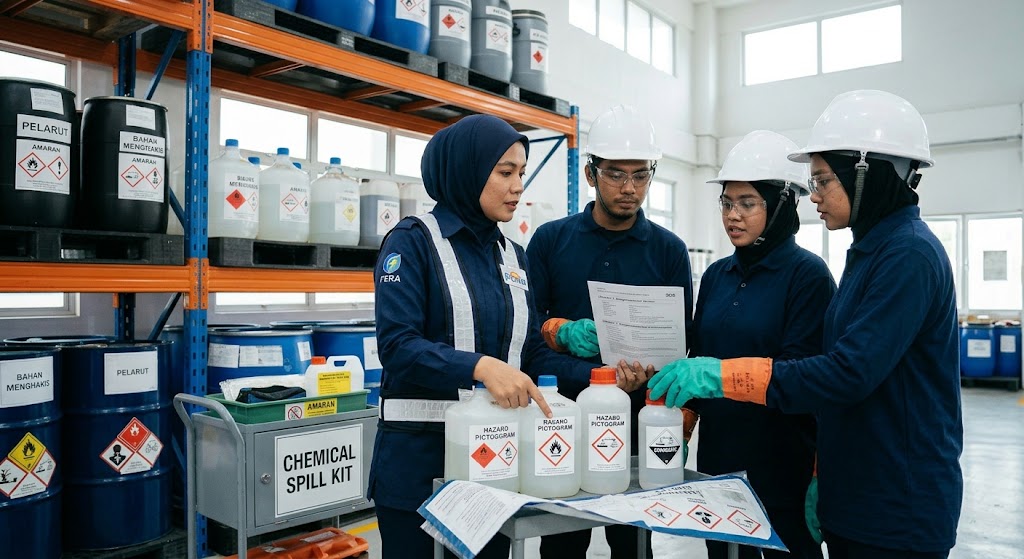
A Safety Data Sheet Malaysia workplace uses is more than a chemical document kept inside a file.
It helps employers, safety officers, supervisors and emergency response teams understand chemical hazards before an incident happens.
Many workplaces store or use chemicals every day. These may include cleaning agents, paints, solvents, adhesives, fuels, lubricants, laboratory chemicals, production materials and maintenance products.
Some chemicals may create fire risks. Others may cause health effects, release vapours, react with incompatible substances or require specific spill response procedures.
When employees do not understand the chemicals they handle, a small mistake can become a serious workplace emergency.
A proper SDS helps an organisation understand the hazard, select suitable controls and prepare a safer response plan.
Organisations can strengthen chemical safety awareness through FERA’s HAZMAT and workplace emergency response training.
What Is a Safety Data Sheet?
A Safety Data Sheet, commonly known as an SDS, is a document that explains the hazards of a chemical and how it should be handled safely.
An SDS normally provides information about:
- Chemical identity
- Hazard classification
- Safe handling
- Storage conditions
- Personal protective equipment
- First aid measures
- Firefighting measures
- Spill response
- Disposal considerations
In Malaysia, hazardous chemical classification, labelling and Safety Data Sheet requirements are linked to the Occupational Safety and Health (Classification, Labelling and Safety Data Sheet of Hazardous Chemicals) Regulations 2013, commonly known as the CLASS Regulations.
The SDS should not be treated as a document for safety officers only.
Supervisors, storekeepers, maintenance teams, Emergency Response Team members and employees who handle chemicals should understand the parts of the SDS that affect their work.
Why SDS Matters for Workplace Safety
A chemical label may provide basic warning information.
However, the SDS gives more detailed guidance.
For example, a chemical label may show that a product is flammable. The SDS may provide additional information about:
- Flash point
- Suitable extinguishing media
- Unsuitable extinguishing media
- Incompatible materials
- Safe storage conditions
- Spill control measures
- Required PPE
This information helps the workplace make safer decisions.
Without SDS information, employees may store incompatible chemicals together, use unsuitable gloves or choose the wrong response during a spill.
The SDS also supports emergency planning.
When a chemical spill, fire or exposure occurs, trained responders need fast access to reliable information.
They should not need to guess how a chemical may behave during an emergency.
SDS and CLASS Regulations in Malaysia
Malaysia’s CLASS Regulations help ensure that sufficient hazard information is available for hazardous chemicals used at workplaces.
Supplier responsibilities may include:
- Chemical classification
- Labelling
- Safety Data Sheet preparation
- Suitable packaging
- Chemical inventory information
Employers should also ensure that SDS documents remain available and relevant for hazardous chemicals present at the workplace.
Employees who need the information should be able to access it quickly.
An SDS that exists only inside an office filing cabinet may have limited value during a warehouse spill or production emergency.
Who Should Read the SDS?
Different people use different sections of an SDS.
For example:
- Storekeepers need storage and incompatibility information.
- Supervisors need handling precautions and emergency procedures.
- First aiders need exposure and first aid information.
- ERT members need firefighting, spill response and PPE information.
- Maintenance teams need hazard and handling information.
- Procurement teams should review SDS documents before introducing a new chemical.
- Employees should understand the sections relevant to the chemicals they use.
This helps prevent chemicals from entering the workplace before management understands the associated hazards.
The SDS creates the most value when people use it before work begins, not only after something goes wrong.
The 16 Sections of an SDS
A standard SDS generally follows a 16-section structure.
These sections help users find important information quickly during normal operations and emergencies.
The sections typically cover:
- Identification
- Hazard identification
- Composition and ingredients
- First aid measures
- Firefighting measures
- Accidental release measures
- Handling and storage
- Exposure controls and PPE
- Physical and chemical properties
- Stability and reactivity
- Toxicological information
- Ecological information
- Disposal considerations
- Transport information
- Regulatory information
- Other information
Employees do not need to memorise every line.
However, they should know where to find the information that affects their job.
A warehouse employee may use the handling and storage section more often.
Meanwhile, an Emergency Response Team member may focus on firefighting, accidental release and exposure controls.
Section 1: Product Identification
Section 1 identifies the chemical or product.
It may include:
- Product name
- Recommended use
- Supplier details
- Emergency contact information
Employees should confirm that the SDS matches the exact product used on site.
A similar product name does not always mean that the chemical has the same hazard profile.
Different grades, concentrations or formulations may behave differently.
Workplaces should therefore avoid using an old SDS for a new product without first checking whether it still applies.
Section 2: Hazard Identification
This section explains the main hazards associated with the chemical.
Information may include:
- Hazard classification
- Signal words
- Hazard statements
- Precautionary statements
- Hazard pictograms
A chemical may be:
- Flammable
- Corrosive
- Toxic
- Irritating
- Reactive
- Environmentally hazardous
The hazard identification section helps employees understand the seriousness of the material before handling it.
Management can also use this section when deciding whether additional training, storage controls or emergency arrangements are required.
Section 3: Composition and Ingredients
Section 3 explains the chemical ingredients or hazardous components.
This information can help safety teams and emergency responders understand what the product contains.
For mixtures, the ingredient details may also explain why two products with similar uses have very different hazards.
Employees should not assume that two cleaners, paints or solvents behave in the same way simply because they perform a similar function.
Section 4: First Aid Measures
This section explains what to do if someone is exposed to the chemical.
It may cover:
- Inhalation
- Skin contact
- Eye contact
- Ingestion
First aiders should know where to find this information quickly.
However, employees should not wait for an exposure to happen before reviewing the SDS.
If a workplace uses corrosive, toxic or hazardous chemicals, supervisors and first aiders should review the relevant information during preparation and training.
FERA’s Rescue and First Aid training can support broader workplace emergency preparedness.
Section 5: Firefighting Measures
This section is especially important for workplace fire safety.
It may explain:
- Suitable extinguishing media
- Unsuitable extinguishing media
- Specific fire hazards
- Hazardous combustion products
- Protective actions for firefighters
Some chemicals may release dangerous gases when they burn.
Others may react with water or require specific firefighting methods.
Employees should not assume that every chemical fire can be handled with the nearest extinguisher.
The firefighting section helps safety personnel connect chemical hazards with emergency response planning.
Section 6: Accidental Release Measures
Section 6 explains what to do when a chemical leaks or spills.
It may include:
- Personal precautions
- Environmental precautions
- Containment methods
- Clean-up guidance
- Emergency PPE
A small spill may require a different response from a large chemical release.
The SDS may also warn workers not to allow a chemical to enter drains or waterways.
Workplaces that store hazardous chemicals should prepare suitable spill response arrangements based on the actual products used.
FERA’s HAZMAT Operation and Chemical Spillage Training covers areas such as hazard identification, PPE, containment and practical response.
Section 7: Handling and Storage
This section supports daily workplace safety.
It may explain:
- Ventilation requirements
- Ignition controls
- Incompatible materials
- Temperature limits
- Safe container handling
- Storage precautions
Many chemical incidents happen because storage practices gradually become poor.
Containers may lose labels.
Chemicals may be moved into unsuitable areas.
Incompatible products may be stored together because employees focus on available space rather than chemical hazards.
Warehouse and store personnel should understand this SDS section clearly.
Section 8: Exposure Controls and PPE
Section 8 explains how employees should reduce chemical exposure.
It may include:
- Ventilation
- Engineering controls
- Respiratory protection
- Gloves
- Eye protection
- Protective clothing
PPE should not be selected by guesswork.
Different chemicals can affect glove and protective materials differently.
A glove that works well for one chemical may not suit another.
The SDS helps the workplace understand the recommended protection.
However, management should also consider the real working conditions, duration of exposure and way the task is performed.
Sections 9 to 11: Properties, Stability and Health Effects
These sections provide more technical information about the chemical.
They may include:
- Appearance
- Odour
- Flash point
- Boiling point
- Vapour pressure
- Stability
- Reactivity
- Conditions to avoid
- Incompatible materials
- Hazardous decomposition products
- Health effects
This information can help safety teams decide whether a chemical requires special storage, ventilation or emergency controls.
It may also become useful during incident investigation.
Sections 12 to 16: Disposal, Transport and Regulatory Information
The later SDS sections usually cover:
- Environmental information
- Disposal
- Transport classification
- Regulatory information
- Revision details
Employees should not dispose of hazardous chemicals through normal waste or drains unless the organisation’s procedure and applicable requirements allow it.
Transport information also matters when chemicals move between warehouses, project sites, customers or contractors.
The final section may show the SDS revision date.
This helps management identify whether the document may be outdated.
How SDS Supports Fire Risk Assessment
A workplace fire risk assessment should consider the chemicals stored or used at the premises.
The SDS can help identify:
- Flammable materials
- Oxidising chemicals
- Reactive chemicals
- Hazardous vapours
- Chemicals that produce toxic smoke
- Chemicals that react with water
- Materials that require special storage
This information can influence:
- Chemical segregation
- Storage planning
- Ventilation
- Ignition control
- Emergency response
- Employee training
A chemical store may look organised but still contain incompatible substances.
The SDS helps management identify these risks before an incident occurs.
SDS and Chemical Storage
Chemical storage should follow the relevant information provided in the SDS.
Employees and supervisors should check:
- Temperature requirements
- Ventilation requirements
- Chemical incompatibility
- Container instructions
- Ignition restrictions
- Segregation requirements
Flammable liquids may need different controls from corrosive chemicals.
Oxidisers should not simply be treated like ordinary cleaning products.
Containers should remain properly labelled and closed when they are not being used.
Storage areas should also remain accessible for inspection and emergency response.
SDS and Emergency Response Team Planning
An Emergency Response Team needs chemical information before a spill, fire or exposure happens.
The SDS helps ERT members understand:
- What hazards may develop
- What PPE may be required
- Which firefighting method may be suitable
- Which response actions may be unsafe
- Whether water should be avoided
- How spills should be contained
- What first aid may be needed
ERT members should not depend on memory alone during an emergency.
Organisations should provide quick access to SDS information in areas where chemicals are stored or used.
Digital copies can be useful.
However, management should also consider what happens if power, internet access or devices become unavailable.
FERA’s Emergency Response Team training can support organisations that want clearer emergency roles and stronger response coordination.
Common SDS Mistakes in Workplaces
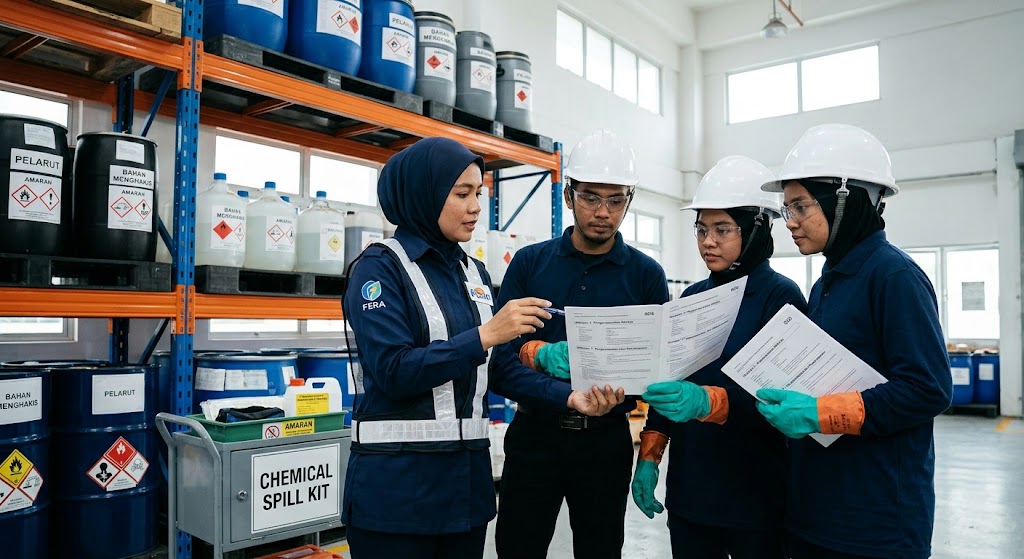
One common mistake is keeping SDS documents but never training employees to use them.
Other common problems include:
- Keeping outdated SDS documents
- Using an SDS from an old supplier
- Keeping SDS only in the main office
- Failing to review storage recommendations
- Ignoring PPE information
- Not updating spill procedures
- Employees not knowing where the SDS is located
- Introducing chemicals before reviewing their hazards
- Keeping documents only for audits
An SDS should influence workplace decisions.
It should not exist only to satisfy documentation requirements.
How to Manage SDS Documents Properly
A simple SDS management system can improve chemical safety.
The workplace can follow several practical steps:
- Request the latest SDS before purchasing a new chemical.
- Confirm that the SDS matches the exact product.
- Review the main hazards.
- Decide whether the chemical can be used safely.
- Review storage and segregation requirements.
- Confirm required PPE.
- Update spill and emergency procedures where necessary.
- Keep the SDS accessible.
- Train relevant employees.
- Review the document when products, suppliers or processes change.
Employees should also know who to contact when an SDS is missing.
A good SDS system makes information available before work starts.
SDS Training for Employees
SDS training does not need to turn every employee into a chemist.
The aim is to help employees understand enough of the document to protect themselves and respond correctly.
Training should show employees how to:
- Find the correct SDS
- Identify the product
- Read hazard pictograms
- Understand the main hazards
- Find first aid information
- Find firefighting information
- Find spill response information
- Check PPE requirements
- Review storage precautions
- Recognise when to stop work
Practical examples can make training more effective.
For example, a trainer may compare two SDS documents and show why similar chemicals require different storage or PPE.
FERA’s HAZMAT Operation and Chemical Spillage Training provides practical learning for teams that need stronger chemical emergency response capability.
SDS for Contractors and Visitors
Contractors may bring chemicals into a workplace during:
- Maintenance
- Cleaning
- Painting
- Repair work
- Installation work
- Shutdown activities
The host organisation should not allow unknown chemicals onto the site without suitable review.
Before work begins, contractors should provide SDS documents for the products they intend to use.
The workplace should check whether the chemical creates fire, health or environmental risks that may affect employees or operations.
This becomes particularly important during:
- Hot work
- Confined-space entry
- Production shutdowns
- Maintenance
- Work near ignition sources
Chemical control should form part of the contractor safety process.
SDS and Incident Investigation
After a chemical spill, exposure or fire, the SDS can support incident investigation.
Management can review:
- Whether employees followed handling instructions
- Whether storage requirements were followed
- Whether correct PPE was used
- Whether spill procedures matched SDS guidance
- Whether firefighting actions were suitable
- Whether the SDS was accessible
- Whether the document was current
If the SDS was unavailable, outdated or ignored, this becomes an important finding.
The purpose of the investigation should not only be to identify what went wrong.
It should also help the organisation improve chemical management, training and emergency preparedness.
Build Stronger Chemical Safety with FERA
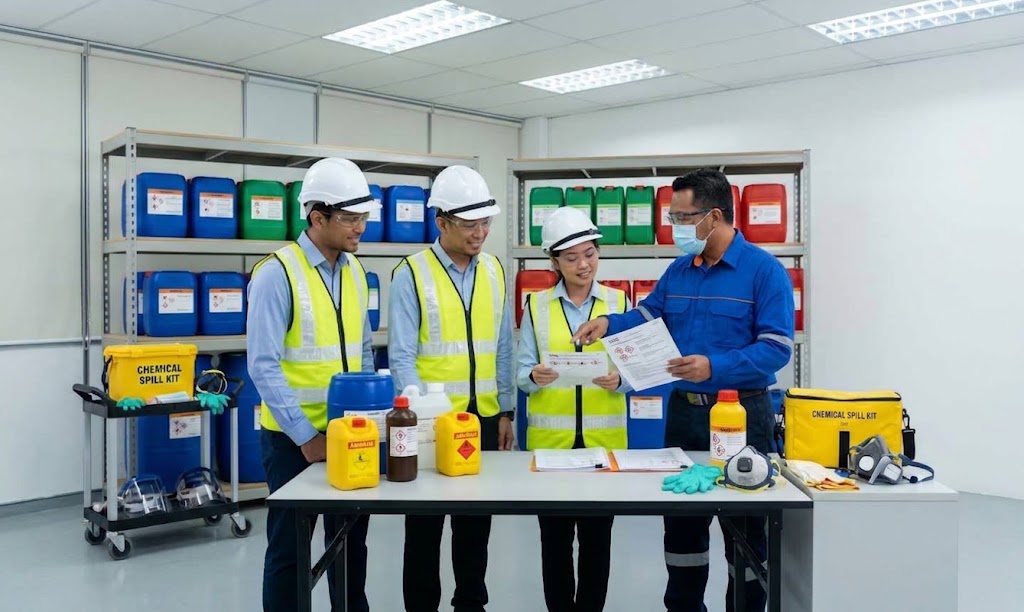
A Safety Data Sheet Malaysia workplace uses should become part of daily chemical safety.
The document helps employers understand hazards, select controls and prepare suitable emergency procedures.
However, an SDS only creates value when employees know how to read and apply the relevant information.
Organisations that handle chemicals should train the right people, keep SDS documents accessible and review the information whenever operations change.
FERA provides HAZMAT, Emergency Response Team, fire safety, first aid and workplace emergency training for Malaysian organisations.
Explore FERA’s fire safety and emergency response training programmes to strengthen employee awareness and workplace readiness.
Conclusion
A Safety Data Sheet is one of the most useful chemical safety documents in the workplace.
It explains chemical hazards and provides important information about storage, PPE, first aid, firefighting and spill response.
However, the document should not remain unread inside a folder.
Employers should use SDS information to improve risk assessment, emergency procedures, employee training and chemical storage practices.
Employees should also know where to find the SDS and how to use the sections that affect their work.
When an organisation manages SDS documents properly, it becomes better prepared to prevent chemical incidents and respond safely when something goes wrong.
Organisations that want to strengthen HAZMAT and chemical emergency readiness can contact FERA Training Center to discuss suitable workplace training.
Questions & Answers
What is a Safety Data Sheet?
A Safety Data Sheet provides information about a chemical’s hazards, handling, storage, PPE, first aid, firefighting and spill response.
Is SDS required for hazardous chemicals in Malaysia?
Hazardous chemical classification, labelling and Safety Data Sheet requirements are covered under Malaysia’s CLASS Regulations 2013.
Who should read the SDS at work?
Safety personnel, supervisors, storekeepers, first aiders, ERT members, maintenance teams and employees who handle chemicals should understand the sections relevant to their roles.
Where should SDS documents be kept?
SDS documents should be accessible to employees who use, store or respond to incidents involving the chemical.
How often should SDS documents be reviewed?
They should be reviewed when chemicals, suppliers, formulations, processes or relevant information change.
Can an SDS help during a fire?
Yes. The firefighting section can provide information about suitable extinguishing media, specific hazards and protective actions.
Can an SDS help during a chemical spill?
Yes. The accidental release section can provide information about containment, personal precautions and spill response.
Does FERA provide chemical safety training?
Yes. FERA provides HAZMAT, Emergency Response Team and related workplace emergency training for organisations handling chemical risks.