



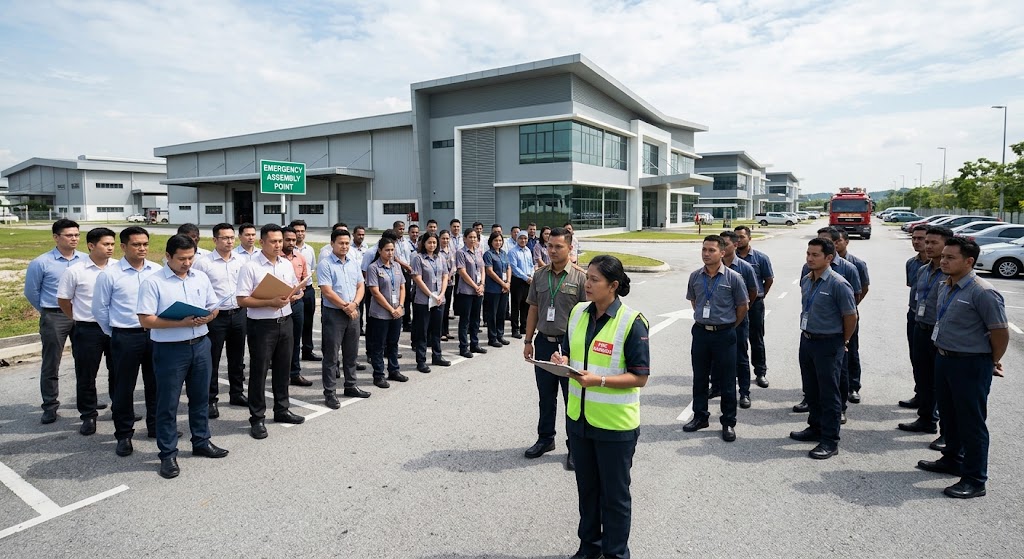
An emergency assembly point Malaysia workplace uses should not be treated as just an outdoor signboard.
During a fire or emergency evacuation, the assembly point becomes the location where employees, visitors and contractors gather so the organisation can confirm who has safely left the building.
A clear assembly point helps management complete headcounts, identify missing persons and communicate with fire wardens, Emergency Response Team members and emergency responders.
Without a proper assembly point, people may gather in different areas. Some may leave the premises too early, while others may stand too close to the building or block emergency access.
For this reason, every workplace should plan, mark and practise its assembly point procedure before an actual emergency happens.
Organisations can strengthen evacuation readiness through FERA’s fire safety and emergency response training programmes.
What Is an Emergency Assembly Point?
An emergency assembly point is a designated safe location where people gather after leaving a building during an emergency.
The location allows supervisors, fire wardens or assigned personnel to confirm whether everyone has evacuated safely.
A workplace may have one assembly point or several assembly points depending on the size, layout and number of occupants.
For example, a small office may only need one external meeting point. However, a factory, warehouse, campus or multi-building facility may require several assembly areas to avoid overcrowding.
The assembly point should be clearly marked, easy to identify and included in the workplace evacuation plan.
Employees should know where to go before an emergency occurs.
Why the Assembly Point Matters
Evacuation does not end when employees leave the building.
The organisation still needs to know whether everyone is safe.
A proper assembly point supports this process by giving employees, visitors and contractors one clear place to gather.
It also helps emergency controllers receive updates from fire wardens, supervisors and department representatives.
If someone is missing, management can then provide more accurate information to emergency responders.
Employees should never re-enter a building simply because someone appears to be missing.
Instead, trained emergency responders should receive the available information and decide the appropriate action.
What Makes a Good Assembly Point?
A good assembly point should be far enough from the building to reduce exposure to smoke, heat and emergency operations.
At the same time, it should remain practical for occupants to reach safely.
The location should not block fire engines, ambulance access, hydrants, gates or internal traffic routes.
It should also provide enough space for the expected number of employees, visitors and contractors.
Management should consider:
- Weather conditions
- Lighting
- Ground condition
- Vehicle movement
- Emergency access
- Number of occupants
- Nearby hazards
For example, placing an assembly point beside a busy road may introduce another risk during evacuation.
The best location is one that employees can reach safely while emergency responders still have clear access to the premises.
Assembly Point Signage
An assembly point should be easy to recognise.
Clear signage helps employees, visitors and contractors identify the correct location during an evacuation.
The sign should remain visible under normal workplace conditions and should not be blocked by vehicles, landscaping, temporary structures or stored materials.
When a workplace has several assembly points, each location should be named or numbered clearly.
For example:
Assembly Point A – Main Car Park
Assembly Point B – Rear Open Area
This makes reporting clearer for fire wardens and department representatives.
Assembly point signage should also match the workplace evacuation plan and employee briefing.
Headcount During Evacuation
Headcount is one of the most important activities at the assembly point.
Its purpose is to confirm who has reached safety and who may still be missing.
The organisation should decide who performs the headcount before an emergency occurs.
Depending on the workplace, this may include:
- Supervisors
- Department representatives
- Fire wardens
- Emergency Response Team members
- Security personnel
- Other assigned employees
They may use employee lists, visitor records, contractor logs or digital attendance systems.
However, the method must remain simple enough to work during a stressful situation.
A headcount system may look effective on paper but fail when the person responsible cannot access the record quickly.
Therefore, management should test the process during fire drills.

Managing Employees at the Assembly Point
Employees should remain at the assembly point until an authorised person gives further instructions.
They should not leave the site, return to the building or move to another area without informing the person responsible for the headcount.
This is important because an employee who leaves without informing anyone may be recorded as missing.
Supervisors should keep their teams grouped where practical.
This makes the headcount faster and reduces confusion.
Employees should also avoid gathering in areas that block emergency vehicles or access routes.
During training, management should explain that the assembly point is part of the emergency control process, not simply a place to wait.
Managing Visitors and Contractors
Visitors and contractors can create additional headcount challenges because they may not appear on normal employee lists.
Reception, security or the host department should maintain accurate visitor and contractor records.
During an evacuation, the responsible person should be able to access this information where safe and practical.
Visitors should also receive simple emergency instructions when entering the premises.
For contractors, a site briefing should include:
- Alarm signals
- Emergency exits
- Evacuation routes
- Assembly point location
- Emergency contacts
Contractors performing maintenance, hot work or installation activities may work in isolated areas.
Therefore, the organisation should know where they are working and how they will be accounted for during an emergency.
Assembly Points for Multi-Tenant Buildings
Multi-tenant buildings need clear coordination.
Each tenant may have its own employees, visitors and internal headcount method.
However, everyone may share the same staircases, exits and assembly areas.
Building management should communicate the evacuation procedure clearly to all tenants.
Tenants should also brief their employees and maintain accurate visitor records.
Without coordination, different groups may gather at the wrong location or report their status to different people.
The assembly point plan should therefore identify who receives status updates and how missing-person information will be escalated.
Assembly Points for Factories and Warehouses
Factories and warehouses may have larger workforces, shift employees, contractors and vehicle movement.
The assembly point should not sit within forklift routes, loading zones or emergency vehicle access paths.
It should also consider employees working in remote areas such as:
- Storage yards
- Production lines
- Workshops
- Utility rooms
- Loading bays
- Plant rooms
Shift patterns can create additional challenges.
A night shift may not have the same supervisors or support staff as the day shift.
Therefore, the assembly point procedure should work across all operating hours.
Management should test the process during different shifts instead of only during normal office hours.
Assembly Points for Training Centres and Public Facilities
Training centres, event spaces, schools, hotels and public facilities often host people who do not know the building layout.
These occupants may not immediately know where to go when an alarm sounds.
Therefore, clear signage and staff guidance become even more important.
Trainers, teachers, front desk staff or event organisers should know their responsibilities during an evacuation.
They may need to guide visitors, check rooms and confirm attendance after reaching the assembly point.
The procedure should also consider people who may need additional evacuation assistance.
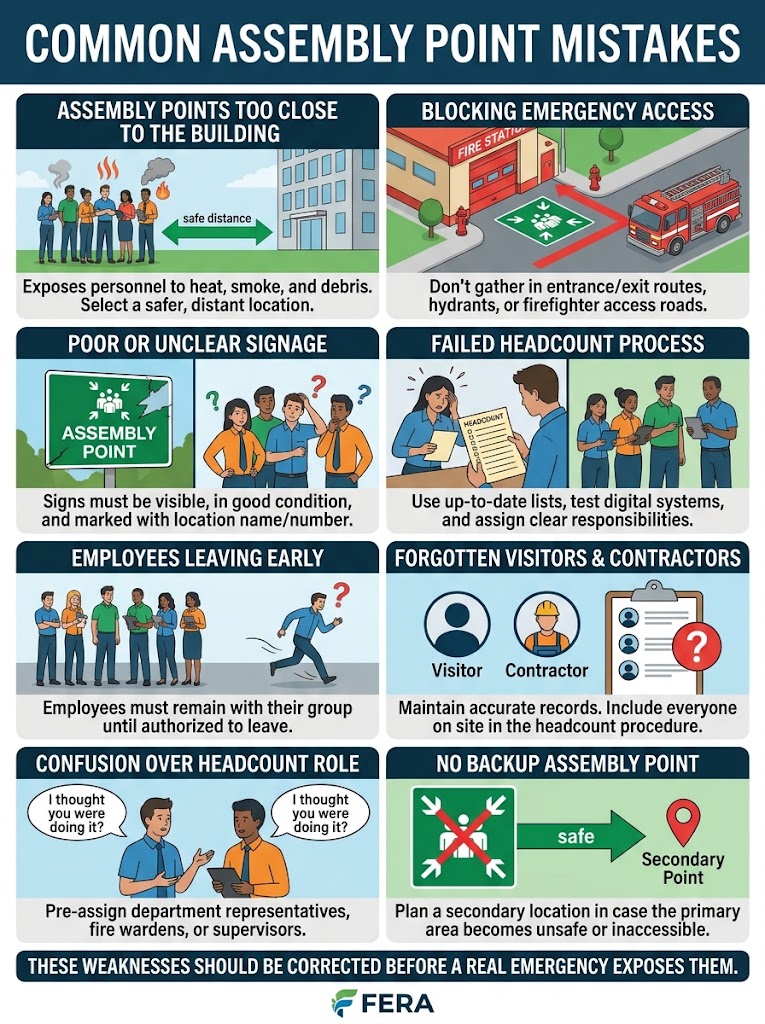
Common Assembly Point Mistakes
One common mistake is placing the assembly point too close to the building.
Another is choosing a location that blocks emergency access.
Some workplaces mark the assembly point clearly but never brief employees on what they should do once they arrive.
Others conduct evacuation drills but fail to test the headcount process properly.
Common problems include:
- Assembly points located too close to the building
- Emergency vehicle access being blocked
- Poor or unclear signage
- Employees leaving before the headcount is complete
- Visitors not being recorded
- Contractors being forgotten
- Outdated employee lists
- Confusion over who performs the headcount
- No backup assembly point
These weaknesses should be corrected before a real emergency exposes them.
The Role of Fire Wardens
Fire wardens support evacuation and assembly point control.
They may guide occupants towards exits, check assigned areas and report the status of their zone.
At the assembly point, fire wardens may also help organise groups and provide updates to the emergency controller.
However, fire wardens should not put themselves in danger or delay their own evacuation unnecessarily.
Their role must be clearly defined before an emergency begins.
Organisations can strengthen these capabilities through FERA’s Fire Warden training.
The Role of the Emergency Controller
The emergency controller coordinates information during an evacuation.
This person may receive updates from fire wardens, supervisors, security personnel and facilities teams.
At the assembly point, the emergency controller needs clear and accurate information.
For example, a report such as:
“Finance team complete. Eighteen employees accounted for. No visitors.”
is far more useful than:
“I think everyone is here.”
The emergency controller should also know who will brief emergency responders when they arrive.
A clear reporting structure helps reduce confusion.
What to Do If Someone Is Missing
If someone appears to be missing, employees should not rush back into the building.
The responsible person should first confirm the information.
The person may be:
At another assembly point
- On leave
- Working from home
- Attending an external meeting
- At another part of the site
After checking the available records, the emergency controller should provide accurate information to emergency responders.
Useful information may include the person’s name, department and last known location.
Only trained emergency responders should decide whether a search should be conducted.
This is why accurate headcount procedures matter.
Assembly Point and Emergency Communication
Communication at the assembly point should remain clear and controlled.
Too many people giving different instructions can create confusion.
The organisation should define who provides official updates.
Supervisors can help keep teams calm and prevent employees from leaving the area.
Security or facilities personnel may also need to communicate with emergency responders at the entrance.
In larger workplaces, radios or designated communication channels may help.
However, employees should avoid spreading unverified information through group chats.
Accurate information is more useful than fast rumours during an emergency.
Assembly Point and First Aid
Some employees may become injured, stressed or unwell during an evacuation.
Therefore, the assembly point procedure should consider first aid support.
First aiders should know where they are expected to position themselves and how to communicate with the emergency controller.
Depending on the workplace risk, first aid equipment may also need to remain accessible.
If someone requires medical attention, the organisation should record what happened and communicate clearly with emergency services.
FERA also provides Rescue and First Aid training for organisations that want to improve workplace emergency readiness.
How Fire Drills Improve Assembly Point Readiness
A fire drill is one of the best ways to test whether an assembly point procedure actually works.
During the drill, observers should check whether employees:
- Use the correct exit
- Reach the correct assembly point
- Remain with their group
- Follow fire warden instructions
- Complete the headcount
- Account for visitors and contractors
- Avoid blocking emergency access
If the headcount takes too long, management should identify the reason.
The problem may involve outdated employee records, unclear responsibilities, weak signage or poor department coordination.
Fire drills allow these weaknesses to be corrected before a real emergency.
Assembly Point Records and Post-Drill Review
After a fire drill, management should review assembly point performance.
The review may include:
- Evacuation time
- Headcount accuracy
- Visitor accountability
- Contractor accountability
- Communication issues
- Incorrect assembly areas
- Missing employee records
- Fire warden observations
- Corrective actions
If employees gather in the wrong location, management should review signage and briefing quality.
If supervisors struggle to account for employees, the headcount method may need improvement.
Every important finding should have a corrective action and person responsible.
Without follow-up, the same weakness may appear during the next emergency.
Assembly Points for People Who Need Assistance
Some occupants may require additional support during evacuation.
This may include people with mobility limitations, temporary injuries or other conditions that affect safe evacuation.
The organisation should plan this support before an emergency.
The procedure should identify who provides assistance and how those occupants will be accounted for at the assembly point.
In some buildings, assisted evacuation arrangements or designated refuge areas may also form part of the emergency plan.
Management should not depend on last-minute improvisation.
Weather and Environmental Conditions
An assembly point should remain practical under different weather conditions.
Heavy rain, extreme heat, haze or poor lighting may affect how long employees can safely remain outside.
Management should consider alternative arrangements where necessary.
For example, a secondary assembly point may be useful when the primary location becomes unsafe or inaccessible.
Night operations should also be considered.
An assembly point that works well during daylight may become difficult to manage after dark if lighting is poor.
Assembly Point and Emergency Vehicle Access
The assembly point must not interfere with emergency vehicles.
Fire engines, ambulances and emergency responders need clear access to the premises.
If employees gather near gates, hydrants, fire appliance access roads or building entrances, they may delay emergency operations.
Management should review the site from an emergency responder’s perspective.
- Can a fire engine enter easily?
- Can security open the gate quickly?
- Are employees gathering in the access route?
- Does the assembly point obstruct firefighting operations?
- These practical questions help improve emergency planning.
Reviewing the Assembly Point After Workplace Changes
Workplaces change over time.
A company may add new buildings, renovate offices, expand storage areas, change parking arrangements or install new security gates.
Any of these changes can affect assembly point safety.
Therefore, the organisation should review the assembly point after significant layout changes.
It should also update evacuation maps, signage and employee briefings.
A location that was suitable two years ago may no longer be appropriate after workplace expansion.
Emergency planning must change with the workplace.
Build Better Evacuation Readiness with FERA
An emergency assembly point helps an organisation confirm who is safe after evacuation.
However, the system only works when employees know where to go, supervisors can complete headcounts and emergency controllers receive accurate information.
The assembly point should be visible, practical and regularly tested during fire drills.
Organisations should also prepare for visitors, contractors, shift workers and people who may need evacuation assistance.
FERA provides fire safety, fire drill, fire warden, first aid and Emergency Response Team training for Malaysian workplaces.
Explore FERA’s fire safety and emergency response training programmes to strengthen workplace evacuation readiness.
Conclusion
An emergency assembly point is more than a sign outside the building.
It is an important part of workplace evacuation, accountability and emergency communication.
A good assembly point helps employees gather safely, allows supervisors to complete headcounts and provides emergency controllers with accurate information.
Businesses should choose the location carefully, mark it clearly and practise the procedure during fire drills.
Visitors, contractors, shift workers and people who may need additional assistance should also be included in the plan.
When the assembly point procedure works together with employee training, fire wardens and a clear emergency response structure, the workplace becomes better prepared for a real fire emergency.
Organisations that want to improve evacuation and workplace emergency readiness can contact FERA Training Center to discuss suitable training for their team.
Questions & Answers
What is an emergency assembly point?
An emergency assembly point is a designated safe location where employees, visitors and contractors gather after evacuating a building.
Why is an assembly point important?
It helps management complete headcounts, identify missing persons and provide accurate information to emergency responders.
Where should an assembly point be located?
It should be far enough from the building and emergency operations while remaining safe and practical for occupants to reach.
Can a workplace have more than one assembly point?
Yes. Large factories, campuses and multi-building workplaces may require several assembly points.
Who should perform the headcount?
Supervisors, fire wardens, department representatives or other assigned personnel may conduct the headcount according to the workplace emergency plan.
What should employees do at the assembly point?
Employees should remain with their group, wait for instructions and avoid leaving or re-entering the building without authorisation.
Should visitors and contractors be included in the headcount?
Yes. The organisation should account for everyone on site, including employees, visitors, contractors and temporary personnel.
What happens if someone is missing?
Employees should not re-enter the building. The emergency controller should verify the information and brief trained emergency responders.
Can fire drills help improve assembly point procedures?
Yes. Fire drills can reveal problems involving headcounts, signage, employee movement, communication and visitor accountability.
Where can companies arrange evacuation and fire safety training?
Companies can explore FERA’s fire safety and emergency response training programmes.