
How to Use an AED During Cardiac Arrest
Introduction
Cardiac arrest can happen anytime, anywhere, and to anyone. In those critical first few minutes, immediate action can mean the difference between life and death.
Knowing how to use an Automated External Defibrillator (AED) correctly can significantly increase survival chances. This guide will walk you through the exact steps to use an AED during a cardiac arrest emergency.
What is an AED and Why is It Important?
An AED (Automated External Defibrillator) is a portable medical device designed to deliver an electric shock to the heart when someone experiences sudden cardiac arrest.
The device helps restore a normal heart rhythm and is safe for use by trained responders and even the public.
Why AED is critical:
- Increases survival rate significantly if used within 3-5 minutes
- Provides voice and visual instructions
- Designed for easy use, even by non-medical personnel
Signs of Cardiac Arrest
Before using an AED, you must identify cardiac arrest quickly.
Common signs include:
- Sudden collapse
- Unresponsive (no reaction when shaken or called)
- Not breathing or only gasping
- No pulse (for trained responders)
If these signs are present, act immediately.
Step-by-Step Guide to Using an AED
Step 1 – Check Responsiveness
Shake the person gently and shout. If no response, proceed immediately.
Step 2 – Call for Help
Call emergency services (in Malaysia dial 999) or ask someone nearby to do it.
Step 3 – Start CPR
Begin chest compressions:
- Push hard and fast (100–120 compressions per minute)
- Depth about 5-6 cm
- Allow full chest recoil
Continue CPR until AED arrives.
Step 4 – Turn On the AED
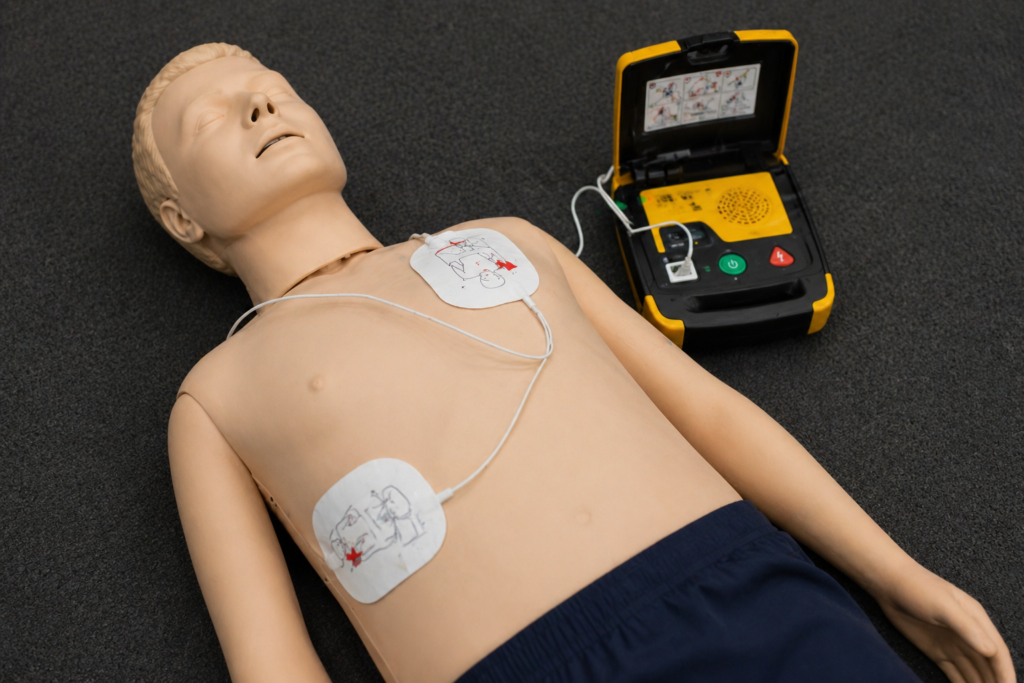
Switch on the AED. The device will give voice instructions automatically.
Step 5 – Attach AED Pads
- Expose the chest
- Place pads as shown on the diagram:
- One pad on upper right chest
- One pad on lower left side
Ensure no one is touching the victim.
Step 6 – Analyze Heart Rhythm
The AED will analyze the heart rhythm.
Important:
- Do not touch the person during analysis
Step 7 – Deliver Shock (If Advised)
If the AED advises a shock:
- Ensure everyone is clear
- Press the shock button
Step 8 – Continue CPR
Immediately resume CPR after the shock.
The AED will continue to guide you until emergency responders arrive.
Safety Tips When Using an AED
Do Not Use AED If:
- The person is in water (move them to dry area first)
- Chest is wet (wipe dry before applying pads)
- Metal surfaces are in direct contact
Special Situations
- Remove excessive chest hair if pads cannot stick
- Avoid placing pads over implanted devices (e.g., pacemaker)
Why Early AED Use Saves Lives
Every minute without defibrillation reduces survival chances by up to 10%.
Using an AED quickly, combined with CPR, dramatically improves survival outcomes.
Who Should Learn to Use an AED?
AED knowledge is essential for:
- Employees in offices and factories
- Safety and Emergency Response Team (ERT) members
- Facility and building managers
- Public areas staff (malls, hotels, airports)
Get Proper Training for AED & CPR
While AEDs are designed for public use, proper training ensures faster, more confident response during emergencies.
Training helps you:
- Perform CPR correctly
- Use AED without hesitation
- Handle real-life emergency scenarios
Equip yourself and your team with life-saving skills through professional AED and CPR training.
Register now: https://wa.me/60122730893
Visit: https://fera.com.my