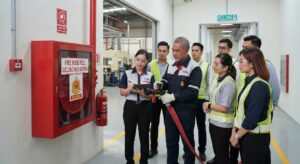



Fire safety induction Malaysia workplaces provide should help new employees understand what to do before they ever face a real emergency.
Starting a new job usually involves learning systems, responsibilities, colleagues and workplace procedures.
Fire safety should be part of that process.
A new employee may know how to perform their job but still have no idea where the nearest emergency exit is, what the fire alarm sounds like or where the assembly point is located.
They may also not know who the fire wardens are or what they should do if they discover smoke or fire.
This is why fire safety induction should form part of a wider workplace safety orientation.
The objective is simple: employees should know how to recognise an emergency, raise the alarm, evacuate safely and follow the workplace emergency procedure.
Organisations can strengthen employee preparedness through FERA’s fire safety and emergency response training programmes.
What Is Fire Safety Induction?
Fire safety induction is an introductory briefing that helps employees understand the fire emergency arrangements at their workplace.
It is particularly relevant for:
- New employees
- Temporary workers
- Contractors
- Interns
- Transferred employees
- Employees moving to a new building or department
The induction should focus on practical information employees may need during an emergency.
This can include:
- Fire alarm procedures
- Emergency exits
- Escape routes
- Assembly points
- Fire wardens
- Emergency contacts
- Basic fire prevention
- Firefighting equipment awareness
- Reporting procedures
The induction does not need to turn every employee into a trained firefighter.
Instead, it gives employees enough information to respond safely during the first critical moments of an emergency.
Why New Employees Need Fire Safety Induction
Experienced employees usually become familiar with their workplace over time.
New employees do not have the same advantage.
They may not know:
- Which staircase leads outside
- Which doors are emergency exits
- What the alarm sounds like
- Where the assembly point is
- Who their fire warden is
- How visitors are evacuated
- Who to contact during an emergency
During normal operations, these gaps may seem minor.
During a fire, they can create confusion.
A good induction reduces that uncertainty before an emergency occurs.
Fire Safety Induction and Workplace Responsibilities
Employers have broader duties to provide employees with suitable information, instruction, training and supervision to support workplace safety.
Malaysia’s Department of Occupational Safety and Health provides workplace safety guidance that reflects these responsibilities under the Occupational Safety and Health framework.
Employees also have responsibilities.
They should follow workplace safety procedures, cooperate with emergency arrangements and avoid actions that may put themselves or others at risk.
Employers can refer to the Department of Occupational Safety and Health Malaysia for official occupational safety and health information.
Fire safety induction helps translate these general responsibilities into practical workplace actions.
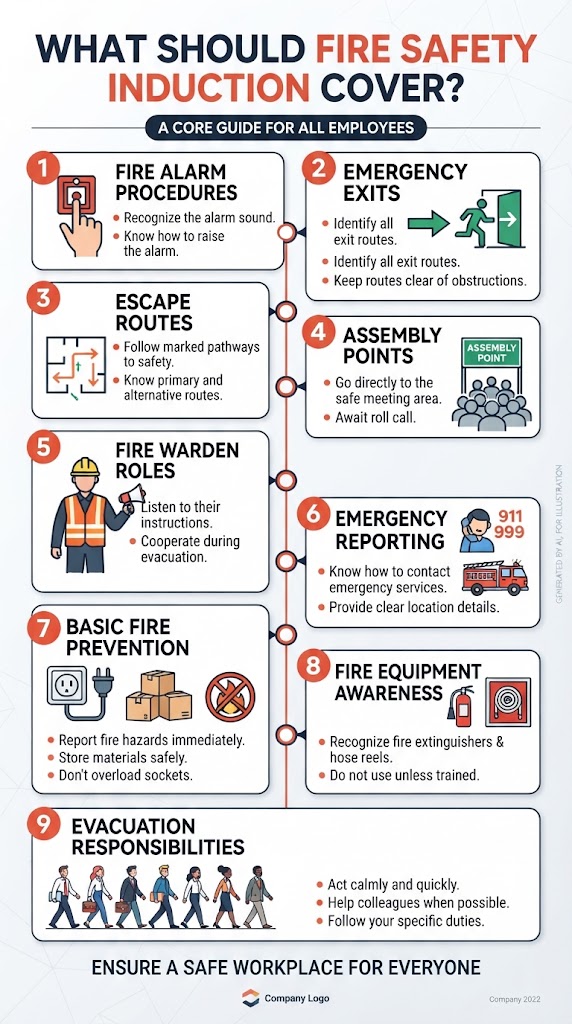
What Should Fire Safety Induction Cover?
The exact induction will depend on the workplace.
However, most employees should understand several core areas.
These include:
- Fire alarm procedures
- Emergency exits
- Escape routes
- Assembly points
- Fire warden roles
- Emergency reporting
- Basic fire prevention
- Fire equipment awareness
- Evacuation responsibilities
The briefing should reflect the actual building rather than relying entirely on generic slides.
Explain the Fire Alarm
New employees should understand how they will know that a fire emergency is happening.
They should know:
- What the alarm sounds like
- What different alarm signals mean, if applicable
- What action to take when the alarm sounds
- Whether they should evacuate immediately
- Where they should go
An employee should not hear the workplace fire alarm for the first time during a real emergency.
The induction should also explain how employees can raise the alarm if they discover a fire.
Show Employees the Emergency Exits
Employees should know the nearest safe exits from their normal work area.
Simply pointing towards an exit sign may not be enough.
Where practical, the induction should show employees the actual evacuation route.
Employees should understand that their normal entrance may not always be the safest evacuation route.
They should also recognise that smoke, fire or other hazards may make one route unavailable.
Therefore, employees should have basic awareness of alternative exits where applicable.
Explain the Escape Route
An emergency exit is only useful when employees know how to reach it.
The induction should explain the main escape route from the employee’s work area.
Employees should be reminded to keep routes clear.
Common obstructions can include:
- Stock
- Furniture
- Boxes
- Trolleys
- Temporary equipment
- Deliveries
Employees should report blocked escape routes instead of assuming someone else will handle the problem.
Identify the Assembly Point
Employees need to know where to gather after evacuation.
The assembly point allows management to account for employees and identify anyone who may still be missing.
The induction should explain:
- Where the assembly point is
- Which group or department employees should join
- Who conducts the headcount
- Why employees should remain there
- Why they should not leave without informing anyone
An employee who leaves the assembly point without telling a supervisor may accidentally be reported as missing.
Explain Fire Warden Responsibilities
New employees should know who their fire wardens are.
Fire wardens may support:
- Evacuation
- Occupant movement
- Area checks
- Assembly point organisation
- Headcounts
- Emergency communication
Employees should understand that fire wardens provide guidance during an emergency.
They should follow instructions calmly and avoid delaying evacuation.
FERA provides Fire Warden training for employees appointed to support workplace evacuation and emergency coordination.
Explain What Employees Should Do If They Discover a Fire
Employees should know the basic reporting sequence before an incident occurs.
Depending on the workplace procedure, this may include:
- Recognise the danger.
- Raise the alarm.
- Warn people nearby.
- Contact the appropriate emergency personnel.
- Move towards a safe exit.
- Report to the assembly point.
Employees should never assume that someone else has already reported the emergency.
However, their own safety should remain the priority.
Fire Extinguisher and Hose Reel Awareness
A fire safety induction may show employees where firefighting equipment is located.
This does not mean every employee should use it.
The induction should explain the difference between:
- Recognising firefighting equipment
- Keeping equipment accessible
- Reporting problems
- Actually operating the equipment
Employees expected to perform an initial firefighting response should receive suitable practical training.
General employees should not interpret the presence of an extinguisher or hose reel as an instruction to fight every fire.
Explain When Evacuation Takes Priority
One of the most important lessons for a new employee is knowing that evacuation may be the correct response.
Employees should not place themselves in danger simply because firefighting equipment is nearby.
Warning conditions may include:
- Rapidly spreading flames
- Heavy smoke
- Intense heat
- Poor visibility
- Hazardous chemicals
- Electrical hazards
- Blocked exits
- Unknown fire conditions
When conditions become unsafe, employees should withdraw and follow the emergency evacuation procedure.
Fire Safety Induction for Office Employees
Office workplaces may appear simple, but employees can still face evacuation challenges.
New staff should understand:
- Floor exits
- Staircases
- Assembly points
- Alarm signals
- Fire warden arrangements
- Visitor responsibilities
They should also understand that lifts may not form part of the normal emergency evacuation route.
Meeting rooms, shared offices and multi-tenant buildings can create additional confusion for new employees.
A short building walkthrough can make the induction much more useful.
Fire Safety Induction for Factories
Factory employees may face additional risks.
These may include:
- Machinery
- Hot work
- Flammable materials
- Chemicals
- Production processes
- Restricted areas
- Vehicle movement
The induction should explain the fire hazards relevant to the employee’s actual work area.
Employees should also know whether certain areas require additional emergency instructions.
Generic office-style fire induction may not be enough for a higher-risk industrial environment.
Fire Safety Induction for Warehouses
Warehouses may contain:
- High-rack storage
- Packaging materials
- Forklift traffic
- Battery charging areas
- Loading bays
- Large floor areas
New employees should understand which routes remain available during an evacuation.

They should also know that stock must not block:
- Fire exits
- Fire extinguishers
- Hose reels
- Alarm points
- Emergency routes
Warehouse layouts can also change over time.
Therefore, fire safety information should be updated whenever significant operational changes occur.
Fire Safety Induction for Contractors
Contractors may only be on site for a short period.
However, they still need basic emergency information.
Contractor induction may include:
- Alarm signals
- Escape routes
- Assembly points
- Emergency contacts
- Restricted areas
- Site-specific hazards
- Permit requirements
This is particularly important for contractors performing:
- Hot work
- Electrical work
- Maintenance
- Confined-space work
- Chemical handling
Contractors may understand their own technical work but still be unfamiliar with the host site.
Fire Safety Induction for Visitors
Visitors usually receive less information than employees.
However, workplaces should still consider how visitors will evacuate.
Reception or host personnel may need to explain:
- Emergency exits
- Assembly point arrangements
- Who will guide visitors
- What to do when the alarm sounds
Employees hosting visitors should understand their responsibilities.
This is especially important in large offices, training centres, factories and industrial sites.
Emergency Contact Information
Employees should know who to contact during an emergency.
This may include:
- Internal security
- Emergency Response Team
- Facilities team
- Supervisor
- Emergency controller
- External emergency services
Contact arrangements should be simple.
Employees should not need to search through several documents during an emergency.
Important numbers can be included in employee handbooks, workplace apps or emergency notices.
Fire Safety Signage During Induction
Fire safety induction is a good opportunity to show employees common workplace safety signs.
These may include:
- Exit signs
- Fire extinguisher signs
- Hose reel signs
- Manual call point signs
- Assembly point signs
- Fire door notices
Employees should understand that signs provide quick guidance during an emergency.
However, signage works best when people already understand its meaning.
This is why training and signage should support each other.
Basic Workplace Fire Prevention
Fire safety induction should also explain how employees can help prevent fires.
Employees may be reminded to:
- Keep exits clear
- Avoid overloading electrical outlets
- Report damaged electrical equipment
- Follow smoking restrictions
- Store combustible materials properly
- Report blocked firefighting equipment
- Follow hot work procedures
- Report unusual smells or overheating equipment
Fire prevention becomes stronger when employees recognise that everyday behaviour affects workplace safety.
Emergency Response Team Awareness
New employees should know whether the organisation has an Emergency Response Team.
They do not need to understand every technical ERT responsibility.
However, they should know:
- Who the ERT members are
- When the team may respond
- Who gives emergency instructions
- How employees should support the response
Clear role awareness reduces confusion.
FERA provides Emergency Response Team training for organisations that want to strengthen emergency roles and workplace coordination.
Include Fire Safety in Employee Orientation
Fire safety should not feel disconnected from the rest of employee onboarding.
HR, safety personnel and supervisors can include it within the normal induction process.
A basic induction sequence may include:
- Welcome and workplace introduction
- General safety rules
- Fire hazards
- Alarm procedure
- Emergency exits
- Assembly point
- Fire warden introduction
- Emergency contacts
- Equipment awareness
- Short workplace walkthrough
This makes fire safety part of the employee’s understanding of the workplace from the beginning.
Use a Workplace Walkthrough
A practical walkthrough can be more effective than explaining everything inside a meeting room.
The supervisor or safety representative can physically show the employee:
- Nearest exit
- Alternative exit
- Staircase
- Alarm point
- Fire extinguisher
- Hose reel
- Assembly point
This makes the information easier to remember.
It also allows employees to ask questions about their actual work area.
Record the Induction
Organisations should keep suitable records of employee safety induction.
A record may include:
- Employee name
- Department
- Date
- Trainer or person providing the briefing
- Topics covered
- Employee acknowledgement
Records help management confirm which employees have completed induction.
They can also help identify employees who need additional training.
However, documentation should support real learning rather than becoming the only objective.
When Should Fire Safety Induction Be Repeated?
Fire safety information should be reviewed when meaningful workplace changes occur.
Examples include:
- Employee transfer
- Workplace relocation
- Major renovation
- Changed evacuation route
- New assembly point
- New emergency procedure
- Significant process changes
- New hazards
- Changes to emergency roles
Employees may also benefit from refresher training and fire drills.
FERA has an existing guide on how often employees should receive fire safety training that can support organisations planning their wider training schedule.
Fire Drills Reinforce the Induction
Induction explains what employees are expected to do.
Fire drills allow them to practise it.
A drill can show whether employees:
- Recognise the alarm
- Leave promptly
- Use the correct exit
- Follow fire wardens
- Reach the assembly point
- Complete the headcount process
If a new employee becomes confused during a drill, management can improve the induction process.
The objective is continuous improvement.
Common Fire Safety Induction Mistakes
A fire safety induction can become ineffective when organisations treat it as a paperwork exercise.
Common mistakes include:
- Providing only generic slides
- Not showing actual exits
- Failing to explain the alarm
- Forgetting the assembly point
- Not introducing fire wardens
- Giving too much technical information
- Failing to cover site-specific hazards
- Not updating the induction after workplace changes
- Assuming experienced employees already know everything
A good induction should be simple, practical and specific to the workplace.
Fire Safety Induction Checklist
Before completing an induction, check whether the employee understands:
- What the fire alarm sounds like
- How to raise the alarm
- Where the nearest exit is
- Where an alternative exit is
- Where the assembly point is
- Who the fire wardens are
- What to do after evacuation
- How to report fire hazards
- Where emergency equipment is located
- That firefighting should only be attempted within their training and assigned role
If the employee cannot answer these basic questions, the induction may need improvement.
Build Employee Fire Readiness with FERA
Fire safety induction provides employees with an important starting point.
However, induction alone cannot replace practical fire safety training.
Employees with specific responsibilities may need additional programmes covering:
- Basic firefighting
- Fire warden duties
- Emergency Response Team roles
- Fire drills
- First aid
- HAZMAT response
FERA provides practical fire safety and emergency response programmes for Malaysian workplaces.
Explore FERA’s complete training programmes to identify training that matches your employees, workplace risks and emergency roles.
Conclusion
Fire safety induction Malaysia workplaces provide should help new employees understand what they need to do during an emergency from their first days at work.
Employees should recognise the alarm, know the escape route, understand the assembly point and know who provides emergency guidance.
They should also understand their own limits.
Not every employee is expected to fight a fire.
For many workers, the most important actions are raising the alarm, evacuating safely and following the workplace emergency procedure.
A practical induction creates this awareness before an emergency happens.
When organisations combine induction with fire drills, role-specific training and clear emergency procedures, new employees can become part of the workplace safety system more quickly.
Organisations that want to strengthen employee fire safety and emergency readiness can contact FERA Training Center to discuss suitable workplace training.
Questions & Answers
What is fire safety induction?
Fire safety induction is an introductory briefing that explains workplace fire hazards, alarms, evacuation routes, assembly points and emergency procedures.
Who should receive fire safety induction?
New employees, contractors, temporary workers, interns and employees transferred to unfamiliar workplaces may require suitable induction.
What should a fire safety induction include?
It should cover alarm procedures, emergency exits, escape routes, assembly points, fire wardens, emergency contacts and basic fire prevention.
Should new employees use firefighting equipment?
Only employees who have suitable training and an assigned role should attempt an initial firefighting response when conditions are safe.
Should the actual evacuation route be shown during induction?
Yes. A practical workplace walkthrough can help employees understand the route better than classroom explanation alone.
Does fire safety induction replace fire drills?
No. Induction explains the procedure, while fire drills allow employees to practise their response.
Should contractors receive fire safety induction?
Yes. Contractors should receive emergency information relevant to the site and the work they will perform.
When should fire safety induction information be reviewed?
It should be reviewed when workplace layouts, evacuation routes, emergency procedures, employee roles or significant hazards change.
Where can organisations arrange fire safety training?
Organisations can explore FERA’s fire safety and emergency response training programmes.