

Why Fire Doors Are Critical in Building Safety
When a fire occurs, every second matters.
Fire alarms, extinguishers, sprinklers, and emergency response teams all help protect lives. However, one important part of building safety is often overlooked: the fire door.
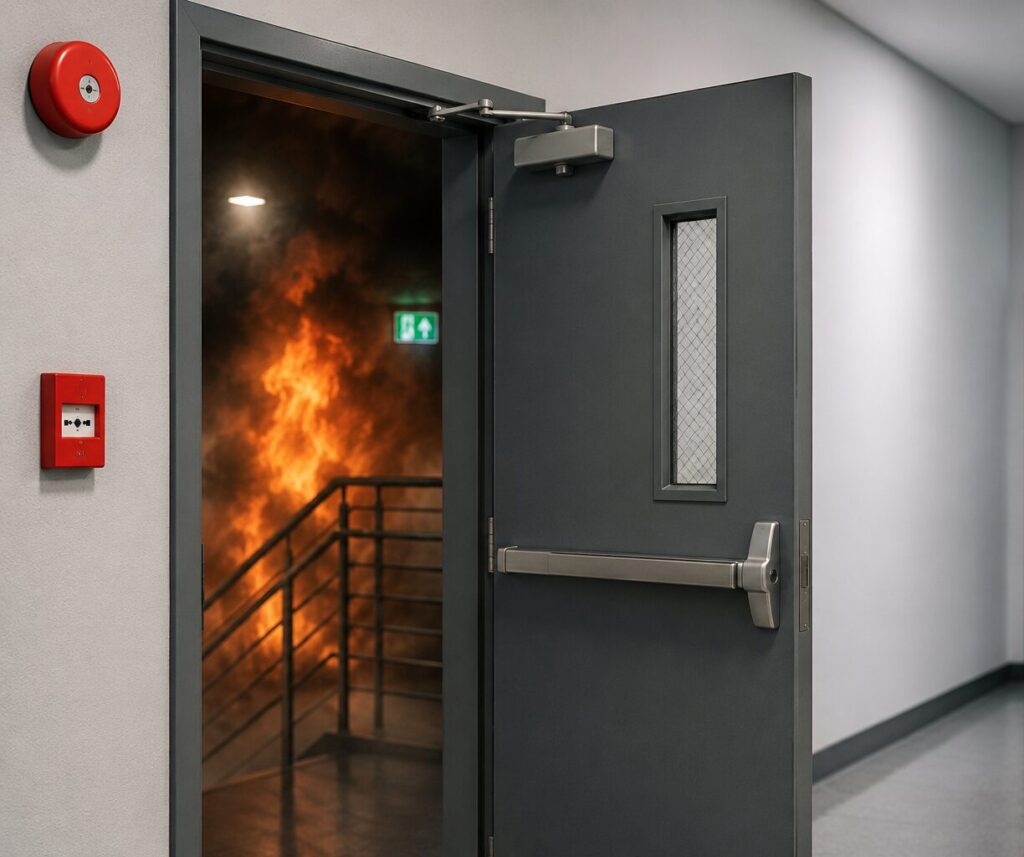
Fire doors are part of a building’s passive fire protection system. They help slow the spread of fire and smoke. They also protect escape routes and give occupants more time to evacuate safely.
However, a fire door can only work properly if it is correctly installed, maintained, inspected, and kept clear at all times.
Fire door safety is important for building owners, facility managers, safety personnel, employees, and anyone responsible for workplace safety.
What Is a Fire Door?
A fire door is a specially designed door that helps slow the spread of fire and smoke between different areas of a building.
Unlike an ordinary door, a fire door is made with fire-resistant materials. It is designed to provide protection for a specific period during a fire.
A complete fire door system may include:
- Fire-resistant door leaf
- Door frame
- Hinges
- Door closer
- Smoke or intumescent seals
- Approved locking or latching devices
- Fire-rated vision panels
Each part must work properly. This helps the fire door provide the intended level of protection.
Why Are Fire Doors So Important?
1. They Help Prevent the Spread of Fire
One main purpose of a fire door is to contain fire within a specific area.
Fire doors slow the movement of flames from one section of a building to another. As a result, they can help prevent a small fire from spreading quickly.
This process is known as fire compartmentation.
Fire compartmentation divides a building into separate areas. It uses fire-resistant walls, floors, and doors.
When a fire door is closed, it helps maintain the protection of these areas.
Without a properly working fire door, flames may spread more quickly through corridors, staircases, offices, and other spaces.
2. They Help Control the Spread of Smoke
Smoke can move quickly through a building. It can also reduce visibility during an emergency.
A properly fitted fire door can help limit the movement of smoke.
This is important because smoke can:
- Reduce visibility
- Cause confusion and panic
- Block escape routes
- Make breathing more difficult
Fire doors with suitable smoke seals provide extra protection against smoke movement.
3. They Protect Emergency Escape Routes
Safe evacuation depends on clear and protected escape routes.
Fire doors are commonly installed near:
- Emergency staircases
- Exit corridors
- Protected lobbies
- Escape routes
- High-risk rooms
- Plant and utility rooms
By slowing fire and smoke, fire doors help keep these areas safer for longer.
This gives occupants more time to reach designated exits. It may also help emergency responders enter the building more safely.
4. They Provide Valuable Evacuation Time
During a fire emergency, extra evacuation time can make an important difference.
A properly working fire door can delay the movement of fire and smoke. This gives occupants more time to:
- Recognise the emergency
- Follow evacuation procedures
- Assist others when needed
- Reach the assembly point safely
This is especially important in large buildings and multi-storey premises. It is also important for people who may need extra help during an evacuation.
Fire Doors Are Part of Passive Fire Protection
Building fire safety includes both active and passive fire protection systems.
Active Fire Protection
Active fire protection systems require activation or action.
Examples include:
- Fire alarm systems
- Automatic sprinkler systems
- Fire extinguishers
- Hose reels
- Fire pumps
Passive Fire Protection
Passive fire protection is built into the structure of a building.
Examples include:
- Fire-rated walls
- Fire-resistant floors
- Fire stopping systems
- Fire compartmentation
- Fire doors
Both systems must work together to support effective building fire safety.
A building may have advanced fire alarms and extinguishing systems. However, damaged or poorly maintained fire doors can still weaken the overall fire safety system.
Learn more about Active and Passive Fire Protection Systems.
Why Fire Doors Must Remain Closed
One common fire safety problem is leaving a fire door open.
People may use objects such as:
- Door wedges
- Chairs
- Boxes
- Fire extinguishers
- Other equipment
This may seem harmless during daily operations. However, it can reduce the effectiveness of the fire door during an emergency.
A fire door should be able to close fully and securely without obstruction.
When a fire door is left open, fire and smoke may spread much faster.
Employees and building occupants should never block or improperly hold open a fire door.
Common Problems Found with Fire Doors
Regular checks are important. They help ensure that fire doors remain in good condition.
Common problems include:
Damaged Door Leaves or Frames
Cracks, holes, or physical damage may affect the performance of the fire door.
Faulty Door Closers
A fire door may fail to provide protection if it cannot close automatically.
Damaged or Missing Seals
Fire and smoke seals should always remain in good condition.
Excessive Gaps Around the Door
Large or uneven gaps may affect the performance of the fire door.
Obstructed Fire Doors
Furniture, equipment, or stored items should never prevent a fire door from closing.
Unapproved Modifications
Drilling holes or changing hardware may affect the integrity of the fire door.
The Importance of Fire Door Inspection and Maintenance
Fire doors should not be treated like ordinary doors.
Regular inspections help identify problems before an emergency occurs.
A basic fire door inspection should check whether:
- The door and frame are in good condition
- The door closes completely
- The self-closing mechanism works properly
- Hinges and hardware are secure
- Seals are present and undamaged
- The door is free from obstruction
- No unauthorised modifications have been made
- Required signs and identification are visible
Any damage or defect should be reported as soon as possible.
Proper maintenance helps ensure that the fire door can perform its intended function.
Who Is Responsible for Fire Door Safety?
Fire safety is a shared responsibility.
Depending on the building, responsibility may involve:
- Building owners
- Employers
- Facility managers
- Safety and Health personnel
- Fire Safety Managers
- Fire Safety Officers
- Emergency Response Team members
- Maintenance personnel
- Building occupants
Management should have clear procedures for inspection, reporting, maintenance, and emergency response.
Employees should also understand basic fire door safety. They should know why fire doors must not be blocked or held open.
Fire Safety Training Strengthens Building Preparedness
Fire protection equipment alone is not enough.
Building occupants must also know how to respond during an emergency.
Fire safety training can help employees understand:
- Workplace fire hazards
- Emergency evacuation procedures
- Fire alarm response
- The importance of fire doors
- Safe use of fire extinguishers
- Emergency roles and responsibilities
- Assembly point procedures
- Basic fire prevention
Organisations should combine proper fire protection systems with regular training and emergency drills.
Explore FERA’s Fire Safety Training Programmes.
Learn more about Emergency Response Team (ERT) Training.
Fire Doors Should Never Be Ignored
Fire doors may look simple, but they play an important role during a fire emergency.
A properly installed and maintained fire door can help:
- Slow the spread of fire
- Reduce smoke movement
- Protect evacuation routes
- Support fire compartmentation
- Provide more evacuation time
- Strengthen overall building safety
However, a damaged or blocked fire door may not work properly when it is needed most.
Building owners, employers, safety personnel, and employees should work together to keep fire doors in good condition.
Build a Safer and More Prepared Workplace with FERA Training Center
Effective fire safety requires more than equipment.
It also requires knowledge, preparation, trained personnel, and regular practice.
FERA Training Center provides practical fire safety and emergency response training. Our programmes help organisations improve workplace preparedness and fire safety awareness.
Our training programmes include:
- Fire Safety Awareness
- Basic Fire Fighting
- Emergency Response Team (ERT) Training
- Fire Warden Training
- Fire Drill Management
- Active and Passive Fire Protection Systems
- Fire Safety Manager (FSM)
- Fire Safety Officer (FSO)